

HONEYWELL TK-FTEB01 fault-tolerant Ethernet interface module
The PowerModule is powered by a series dedicated power supply. Power supplies are available in redundant and non-redundant configurations. The power module is inserted into the left side of each chassis and does not occupy the slot. Power supply Provides DC power for the module inserted into the chassis. On-site power is provided by a separate (external) power supply.
A-series chassis types Chassis vary depending on the number of module positions or slots that can be accommodated in A given chassis. The chassis comes in five versions (4, 7, 10, 13, and 17 slots). Some modules are double wide and will use two chassis positions. Model conventions (TC and TK) All models have either TC or TK in front of them. The TC indicator indicates that the module is not coated with a conformal coating, while the TK indicator indicates that the module is coated with a conformal coating. Other than that, the modules are identical. Supported control processors All CIOM-A I/O modules can be used with the C200E control processor.
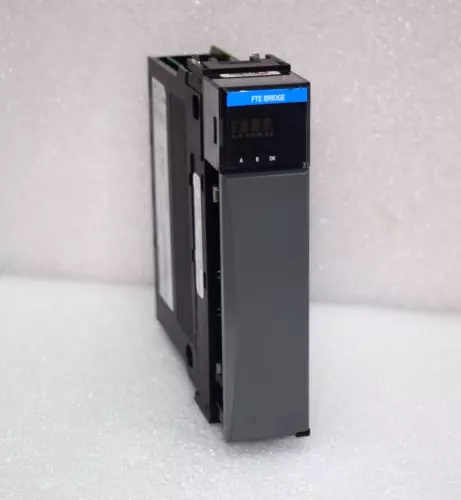
Same series product model
TK-PRS021
TK-IOLI01
TK-FTEB01
TK-FPDXX2
HONEYWELL TK-FTEB01 is a fault-tolerant Ethernet (FTE) interface module of Honeywell. The following is the specific introduction:
Functional characteristics:
Redundant design: Supports redundant functions to enhance system reliability, ensure the stability of network connections, and reduce system interruptions caused by single points of failure.
Port configuration: It features 8 + 1 ports and is a secure choice for the L1 layer control environment. The “1” here is typically the upper connection port, which is used to connect to the upper-layer network and can control the upper connection information, ensuring the highest priority of communication within the cabinet.
Fault diagnosis: Supports power-on and operation self-diagnosis, with a fault indication function, facilitating maintenance personnel to quickly locate and troubleshoot problems.
Storm suppression: It features broadcast information storm suppression function, which can prevent excessive broadcast data packets in the network from causing network congestion, ensuring that the controller is not affected by the upper-layer IP network communication volume and guaranteeing the stable operation of the system.
Optional optical fiber interfaces: Optional optical fiber interfaces are provided, allowing for the use of single-mode optical fibers (with a transmission distance of up to 15 kilometers) or multi-mode optical fibers (with a transmission distance of up to 2 kilometers), meeting the network connection requirements of different distances and environments.
Application scenarios: It is commonly used in large-scale industrial production enterprises, such as petroleum refining and chemical, cement and mining, papermaking and shipbuilding industries, etc., and can be used as the main control module in automated instruments and meters.
Related supporting facilities: This module is part of the Honeywell C300 system. The C300 controller can also be matched with various analog input/output cards, digital input/output cards, etc., such as CC-PAIH01 analog input card (supporting HART protocol), CC-PDOB01 digital output card (24VDC), etc. Realize comprehensive monitoring and control of industrial processes.
Other information: This module was designed by Honeywell and manufactured by AB. It can be regarded as a redundant and fault-tolerant version of AB’s 1756-ENBT, but it cannot be used in AB’s own systems.