

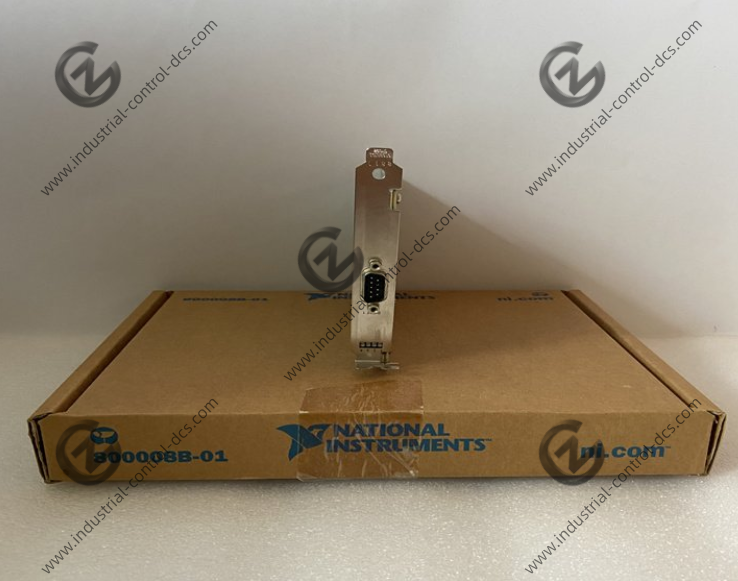
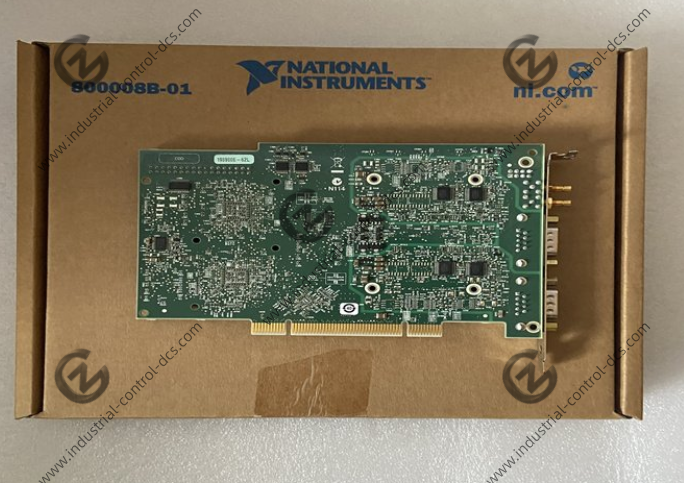
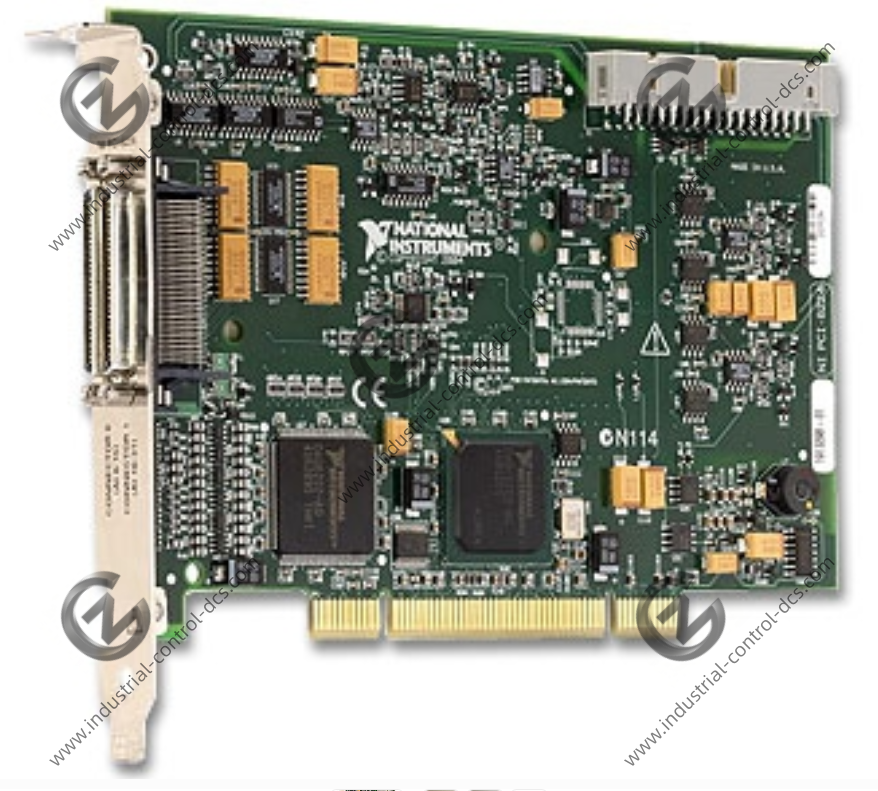
Description
Channel & Physical Interface Configuration
-
Analog Input Configuration: 32 single-ended or 16 fully differential software-switchable channels, no dedicated analog output channels
-
Digital I/O Layout: 48 bidirectional TTL channels divided into 3 ports (Port0:32 lines, Port1/Port2:8 lines each); all pins support independent direction programming
-
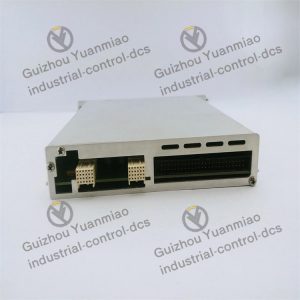
Front Connectors: Dual 68-pin shielded VHDCI female connectors, matched with SHC68-68-EPM shielded cables
-
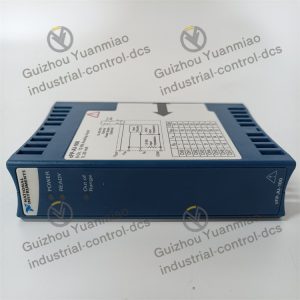
Form Factor: Standard full-height desktop PCI 32-bit 33 MHz card, PCB dimension 155 × 106 mm, bare weight 99 g
-
Front Panel Indicators: Single power status LED, no channel-level activity indicators
Core Analog Input Electrical Parameters
-
ADC Performance: 16-bit resolution, guaranteed zero missing codes; maximum integral nonlinearity (INL) ±76 ppm of full scale
-
Sampling Timing: Aggregate max 250 kS/s across all channels, 50 ns timing resolution, 50 ppm sampling clock accuracy
-
Programmable Input Ranges: ±0.2 V, ±1 V, ±5 V, ±10 V four fixed bipolar ranges
-
Input Impedance: >10 GΩ parallel with 100 pF when powered on; 820 Ω passive discharge resistance when powered off
-
Overvoltage Protection: ±25 V continuous withstand (power-on), ±15 V continuous withstand (power-off), max 20 mA per-pin input current limit
-
Noise & CMRR: 92 dB DC-to-60 Hz common-mode rejection; -75 dB adjacent channel crosstalk at 100 kHz signal input
-
Onboard FIFO: 4,095-sample AI hardware FIFO supporting scatter-gather DMA transmission
Absolute Measurement Accuracy (25℃, 1-year calibration cycle)
-
±10 V Range: 3,100 μV full-scale absolute accuracy, 244 μVrms random noise, 75 ppm residual gain error
-
±1 V Range: 360 μV full-scale absolute accuracy, 30 μVrms random noise, 95 ppm residual gain error
-
±0.2 V Range: 112 μV full-scale absolute accuracy, 13 μVrms random noise, 135 ppm residual gain error
-
Temperature Drift: 25 ppm/℃ gain temperature coefficient, 57 ppm/℃ offset temperature coefficient for ±10V range
-
Settling Time: 7 μs conversion interval for ±1 LSB accuracy on full-scale signal jumps
TTL Digital I/O & PFI Specifications
-
Logic Level Standard: 5 V TTL compatible; input low ≤0.8 V, input high ≥2.0 V
-
Drive Capability: 24 mA sink / 24 mA source per channel for Port0; 8 mA for Port1/Port2/PFI lines
-
PFI Multifunction Lines: 16 programmable PFI pins supporting external trigger, clock input, counter gate and correlated DIO timing
-
Correlated DIO: Hardware-timed digital input/output synchronized with AI sampling clock, max 1 MHz toggle frequency
-
Power-on Default State: All DIO/PFI pins set to high-impedance input with no internal pull resistors
Dual 32-Bit Counter/Timer Resources
-
Counter Structure: Two independent reconfigurable 32-bit up/down counters based on NI TIO ASIC, no shared timing resources
-
Max Input Frequency: 80 MHz for external edge counting, 100 MHz internal timebase operation
-
Supported Modes: Edge counting, pulse width/duty cycle measurement, quadrature encoder decoding (X1/X2/X4), finite pulse generation
-
Trigger & Gating: Software/hardware edge trigger, level gating via PFI external signals
PCI Bus & Synchronization Resources
-
Bus Standard: 32-bit 33 MHz conventional PCI 2.2 specification, 132 MB/s theoretical peak bandwidth
-
Data Transmission Modes: Scatter-gather DMA, interrupt-driven I/O, programmed I/O; DMA for zero-CPU continuous streaming
-
RTSI Synchronization: 8-channel RTSI trigger bus for cross-device synchronization with PCI-4462, PCI-6527 and other NI PCI peripherals
-
Power Consumption: 2.8 W typical, 4.2 W peak under full AI+DIO concurrent operation; powered entirely by PCI slot +5 V rail
Mechanical & Environmental Specifications
-
Operating Temperature: 0 ℃ ~ +55 ℃; Storage Temperature: -20 ℃ ~ +70 ℃
-
Humidity: 10%–90% non-condensing operation, 5%–95% non-condensing storage
-
Safety Rating: IEC 61010-1 Measurement Category I, Pollution Degree 2, max operating altitude 2000 m
-
EMC Compliance: CE, FCC Class A industrial electromagnetic certification, indoor use only
-
Calibration Requirement: 15-minute warm-up before precision measurement, 1-year external traceable calibration cycle
Compatibility Matching List
-
Host Compatibility: Standard desktop PC with vacant 32-bit PCI slot; incompatible with PCIe-only motherboards
-
Matching Accessories: SHC68-68-EPM shielded cable, CB-68LP breakout terminal block, RTSI trigger ribbon cable
-
Peer Device Matching: Synchronizable with legacy NI PCI serial, dynamic signal and counter modules via RTSI
-
Official Status: Fully obsolete, no official new stock, only aftermarket inventory and third-party repair available
Software Compatibility
-
Drivers: NI-DAQmx 9.9 and earlier versions, Traditional NI-DAQ legacy driver dual support
-
Configuration Tools: NI MAX, DAQ Interactive Panel, Signal Express
-
Supported Software: LabVIEW all legacy versions, LabWindows/CVI, Python PyDAQmx, C# DAQ SDK
-
Supported OS: Windows XP/7/10, Phar Lap ETS real-time system; no Windows 11 official driver support
Pros & Limitations
-
Pros: High channel density for multi-point analog acquisition, dual independent counters, hardware-timed correlated DIO, RTSI cross-device synchronization, low CPU load via DMA and large onboard FIFO, excellent low-level DC measurement stability
-
Limitations: No onboard signal galvanic isolation requiring external terminal blocks, no analog output channels, legacy PCI bus incompatible with modern PCIe hosts, limited to CAT I low-voltage measurement, no built-in filtering circuitry
Reviews
There are no reviews yet.