

Description
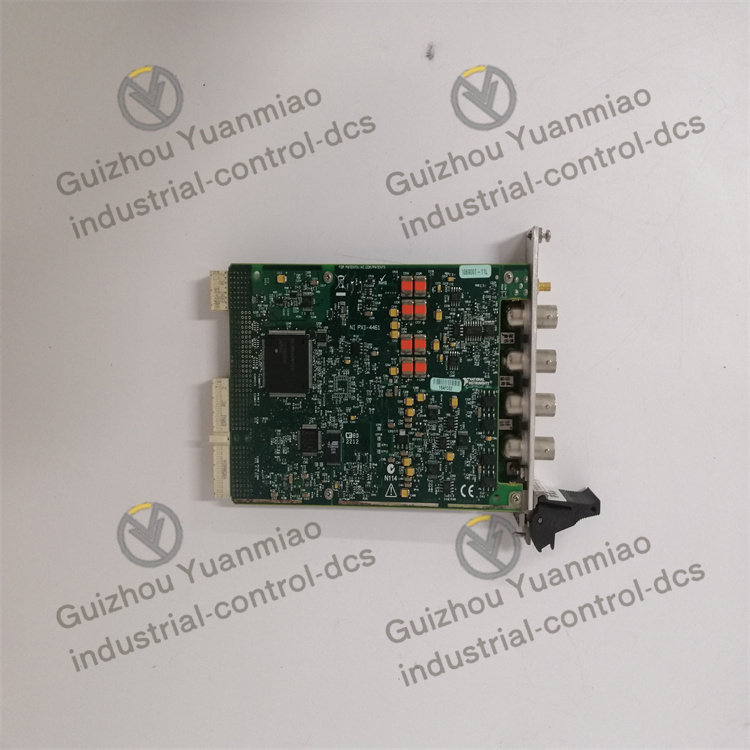
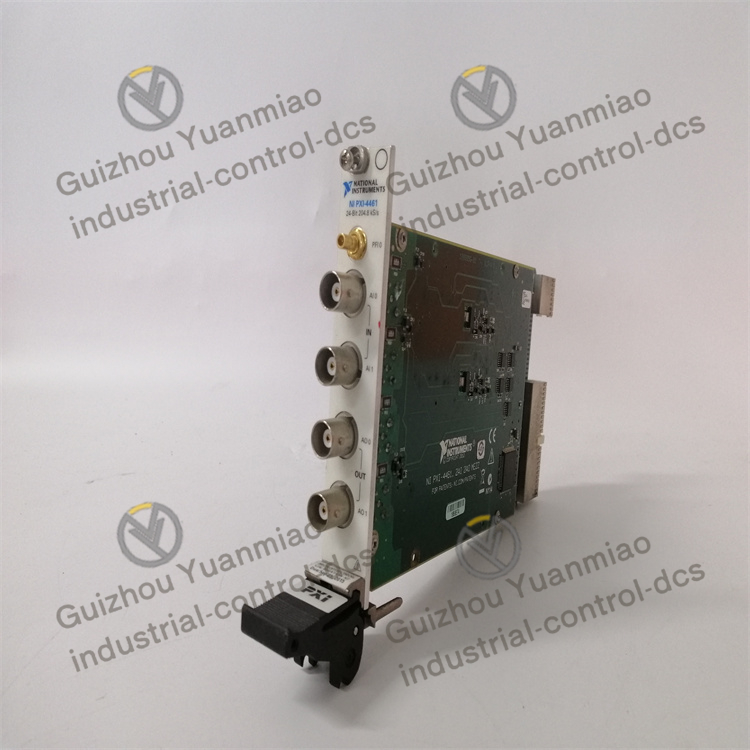
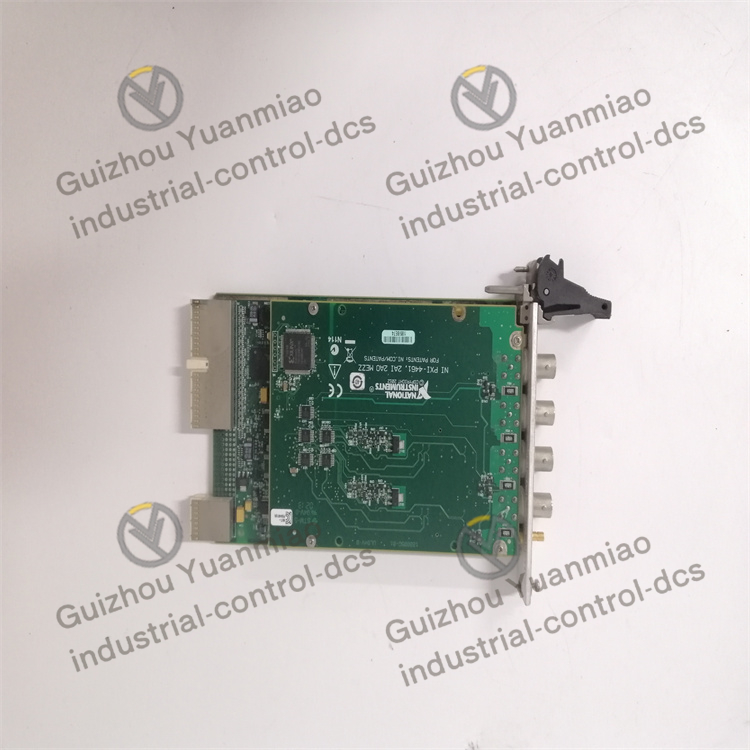
NI PXI-4461 Sound and Vibration Measurement Module
Data characteristics:
High resolution: It adopts a 24-bit resolution analog-to-digital converter, which can precisely collect and quantify sound and vibration signals, capture the subtle changes of the signals, achieve high-precision measurement, and reduce the impact of noise.
High sampling rate: The maximum sampling rate can reach 204.8kS/s, enabling rapid signal acquisition and accurate capture of rapidly changing sound and vibration signals, such as the instantaneous peaks of mechanical vibrations and the high-frequency components of audio signals.
Wide dynamic range: With a dynamic range as high as 110dB, it can measure signals within a wide amplitude range. Whether it is a weak sound signal or a strong vibration signal, it can effectively measure without losing information due to excessive or insufficient signal amplitude.
Dual-channel design: It provides two analog input channels and two analog output channels. The input channel is used for the acquisition of high-precision sound and vibration signals, while the output channel can be used for signal generation and control, such as generating excitation signals to test the response of the object under test.
Rich signal generation function: Built-in signal generation function, supporting multiple waveform outputs such as sine wave, square wave, and triangular wave, which can be used for system testing and calibration, facilitating users to debug and verify the measurement system.
Support for real-time spectrum analysis: It can conduct real-time spectrum analysis on the collected sound and vibration signals, facilitating users to understand the signal characteristics from the frequency domain perspective. It can be applied in fields such as fault diagnosis and acoustic research, determining the frequency components and energy distribution in the signal through spectrum analysis.
Flexible input configuration: It features software-configurable AC/DC coupling function, allowing for the selection of the appropriate coupling method based on actual measurement requirements. It also supports IEPE (Integrated Electronic Piezoelectric) conditioning and can be directly connected to IEPE sensors, simplifying system connection and configuration.
Good compatibility: Compatible with NI LabVIEW software. With the powerful data processing and analysis functions of LabVIEW, complex data acquisition, signal processing and analysis tasks can be achieved. It also supports NI’s sound and vibration toolkit, further simplifying the work of sound and vibration measurement and analysis.
Working principle
The working principle of the PXI-4461 module mainly revolves around the links of signal acquisition, conditioning, conversion, caching and transmission, as well as signal generation.
Signal reception: Receive analog signals from sensors through analog input channels, such as sound signals collected by microphones and vibration signals collected by accelerometers, etc. This module supports two input terminal arrangements: differential and pseudo-differential. Users can flexibly choose according to the reference mode of the signal source or the device under test to meet different measurement requirements.
Signal conditioning: The signal conditioning circuit preprocesses the original analog signal. Firstly, it can amplify weak signals to reach an appropriate amplitude range, facilitating subsequent processing. Secondly, it can filter out the noise in the signal. Through analog and digital filters, it prevents aliasing and ensures the purity of the signal. Thirdly, it can achieve impedance matching, enabling better connection between the signal source and the subsequent circuit, and reducing signal attenuation and distortion. In addition, PXI-4461 also integrates programmable AC/DC coupling and IEPE (Integrated Electro-piezoelectric) conditioning functions, which can further optimize signal quality.
Analog-to-digital conversion: A 24-bit resolution analog-to-digital converter (ADC) is used to convert the preprocessed analog signal into a digital signal. This process includes three steps: sampling, quantization and encoding. The sampling frequency can reach up to 204.8kS/s, which can quickly capture signal changes. High resolution can precisely quantify the signal and ensure that the converted digital signal can accurately reflect the characteristics of the original analog signal.
Data caching and transmission: The converted digital signal is temporarily stored in the buffer of the module first, and then the data is transferred to the computer memory through interfaces such as the PXI bus with the computer. Computers can utilize relevant software, such as NI LabVIEW, to conduct subsequent processing and analysis on these data, such as spectral analysis, time-domain analysis, etc., in order to obtain information such as the frequency, amplitude, and phase of sound or vibration signals.
Signal generation (Some functions) : The PXI-4461 is equipped with a two-channel dynamic signal generation function. Through the built-in signal generation circuit, it can generate analog signals of various waveforms such as sine waves, square waves, and triangular waves under software control. These signals can be used to test the response of the object under test, or input as excitation signals into devices such as sensors, in combination with signal acquisition functions, to achieve operations such as testing and calibration of the system.
Reviews
There are no reviews yet.