Bentley 3500 Vibration monitoring and protection system
The Bently 3500 Vibration Monitoring and Protection System is an advanced industrial automation solution primarily used for vibration monitoring and protection of rotating machinery. The following is a detailed introduction to it:
-
High Precision and Reliability
By adopting advanced sensing technology and signal processing technology, it can accurately measure vibration data, ensuring stable and accurate operation in various industrial environments, and providing a reliable basis for equipment health assessment.
-
Real-time Monitoring
It provides continuous online vibration monitoring, enabling real-time acquisition of vibration information from mechanical equipment, timely detection of potential fault hazards, and real-time control over equipment operation status.
-
Flexibility and Configurability
Almost all operations of the system can be configured through software. A single module type can be configured for multiple functions, reducing the types and quantities of spare parts, and facilitating system expansion and upgrading. Additionally, it can be easily integrated with other control systems.
-
Multiple Alarm Settings
It offers independent alarm and danger settings for each function. Alarm thresholds can be flexibly set according to different equipment requirements and operating conditions. When vibration values reach or exceed the corresponding thresholds, audible and visual alarm signals are promptly issued to remind operators to take corresponding measures.
-
Redundant Design
It adopts a redundant voting mechanism, such as three independent speed signal inputs (shutdown is triggered if any two detect overspeed), dual verification of shaft vibration + bearing vibration signals, etc., to prevent single sensor misoperation or failure, improving system reliability and stability.
-
Adaptability to Harsh Environments
It has wide adaptability to temperature and humidity ranges, capable of stable operation in temperature environments from -40°C to +70°C and humidity conditions from 0% to 95% (non-condensing), making it suitable for various harsh industrial site environments.
.jpg)
-
Frame
Usually installed in a 19-inch EIA standard rack, with multiple installation methods available, such as panel embedded installation and bulkhead installation. The frame contains multiple slots for installing various functional modules.
-
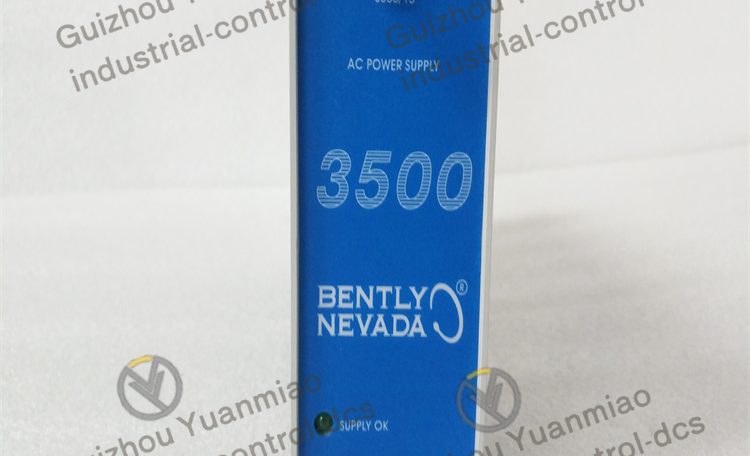
Power Module
Such as the 3500/15 power supply module, which provides stable power input, supports AC or DC input power, and is equipped with a line noise filter to ensure stable system operation in different power environments.
-
Rack Interface Module (RIM)
Namely the 3500/20 module, serving as the basic interface of the 3500 rack, located in the first slot of the rack. It supports the proprietary protocol of Bentley Nevada for rack configuration and retrieving unit information. The front panel is equipped with an RS-232 serial interface, and the rear I/O module has RS-232/RS-422 serial interfaces for connecting with the host computer for data collection and rack configuration.
-
Monitoring Modules
Including the 3500/40M Proximitor displacement monitor, 3500/42M vibration monitoring module, etc. The 3500/40M is mainly used for vibration and displacement monitoring of rotating machinery; the 3500/42 module real-time calculates parameters such as absolute shaft vibration and dynamically compares vibration values with preset thresholds.
-
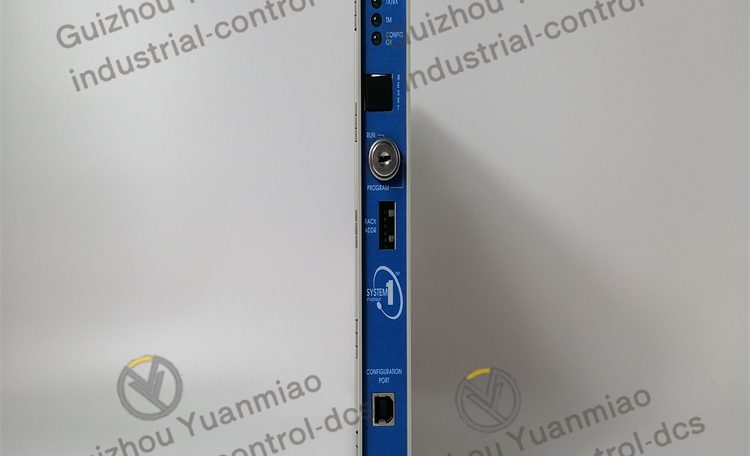
Transient Data Interface (TDI)
Namely the 3500/22 module, serving as the interface between the 3500 monitoring system and Bentley Nevada’s System 1™ mechanical management software. Combining the functions of the 3500/20 rack interface module and communication processor, it can continuously collect steady-state and transient waveform data and transmit the data to the host computer software via Ethernet.
-
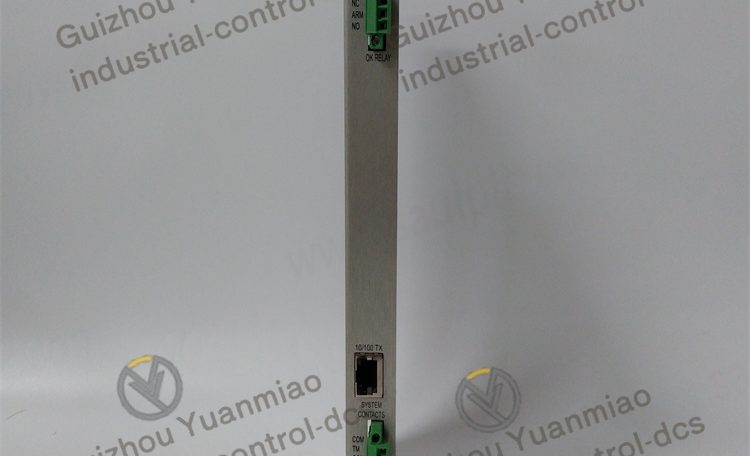
Relay Module
Such as the 3500/32 relay module. When a danger signal is triggered, it outputs passive dry contacts to the external Emergency Trip System (ETS), directly cutting off the power source of the equipment to achieve equipment protection.
bently 3500/05 Instrument frame
bently 3500/15 power supply
bently 3500/20 Framework interface module
bently 3500/22 Framework interface module
bently 3500/25 key phase module
bently 3500/01 framework configuration software
bently 3500/40 monitor module channel types: radial vibration, axial displacement, eccentricity, differential expansion
bently 3500/42 Monitor module Channel types: acceleration, speed, absolute shaft vibration
bently 3500/45 Monitor module channel types: axial displacement, differential expansion, bevel-surface differential expansion, shell expansion, valve position
bently 3500/53 Monitor module Channel type: Overspeed tachometer
bently 3500/32 relay module
bently 3500/33 Relay module
bently 3500/92 Communication gateway module
bently 3500/93, 3500/94, 3500/95 display device monitor
System Framework 3500/05-01-01-00-00-00
Power Module 3500/15-02-02-00 (3500/15-05-05-00 new)
Interface module 3500/22-01-01-00
Bond phase module 3500/25-01-01-00
Speed measurement module 3500/50-01-00-01
Vibration displacement measurement module 3500/42-09-00
Vibration measurement module 3500/42-01-00
Expansion measurement module 3500/45-01-00
Relay module 3500/33-01-00
Configuration Software 3500/1/1
Configuration cable 130118-0010-02
.png)
-
Signal Acquisition
Vibration signals are collected through various sensors. For example, shaft vibration monitoring uses a 3300 XL eddy current sensor to measure the relative displacement between the shaft and bearing; bearing vibration monitoring uses a 9200 series casing vibration sensor or a 177230 vibration transmitter to measure absolute bearing vibration. Meanwhile, key phase signals are obtained through groove/key trigger pulses, providing speed reference and phase reference.
-
Signal Conversion and Transmission
The eddy current sensor signal is converted into a standard voltage by a preamplifier and transmitted to the 3500 rack via a shielded cable; the casing vibration signal is output as a 4-20 mA current by the transmitter and input to the 3500/42M vibration monitoring module.
-
Data Processing and Analysis
The monitoring module performs real-time calculation and analysis on the collected signals, such as calculating parameters like absolute shaft vibration, and compares the vibration values with preset thresholds to determine the equipment’s operating status.
-
Alarm and Protection
When the vibration value reaches the warning alarm threshold, audible and visual prompts are triggered; when it exceeds the danger alarm threshold, the protection logic is activated. A signal is output to the ETS system via the relay module to cut off power sources such as the equipment’s steam inlet valve, achieving equipment protection. Meanwhile, the system also has a sensor failure detection function: when the signal is 10% lower than the normal value, a “Sensor Fault” alarm is triggered.
-
Power Industry
Used for vibration monitoring and protection of large rotating machinery such as steam turbines and generators, ensuring stable unit operation and preventing equipment damage and power outages caused by abnormal vibration.
-
Petrochemical Industry
It can conduct real-time monitoring of equipment such as compressors, pumps, and fans, promptly detect equipment fault hazards, and ensure the continuity and safety of the production process.
-
Metallurgical Industry
In the steel production process, vibration monitoring of equipment such as rolling mills, fans, and motors helps optimize equipment operation parameters and improve equipment service life and production efficiency.
-
Other Industries
Rotating machinery in industries such as aerospace, marine, papermaking, and cement also widely applies the Bently 3500 vibration monitoring and protection system to achieve equipment condition monitoring and fault prevention, enhancing equipment reliability and operation efficiency.