

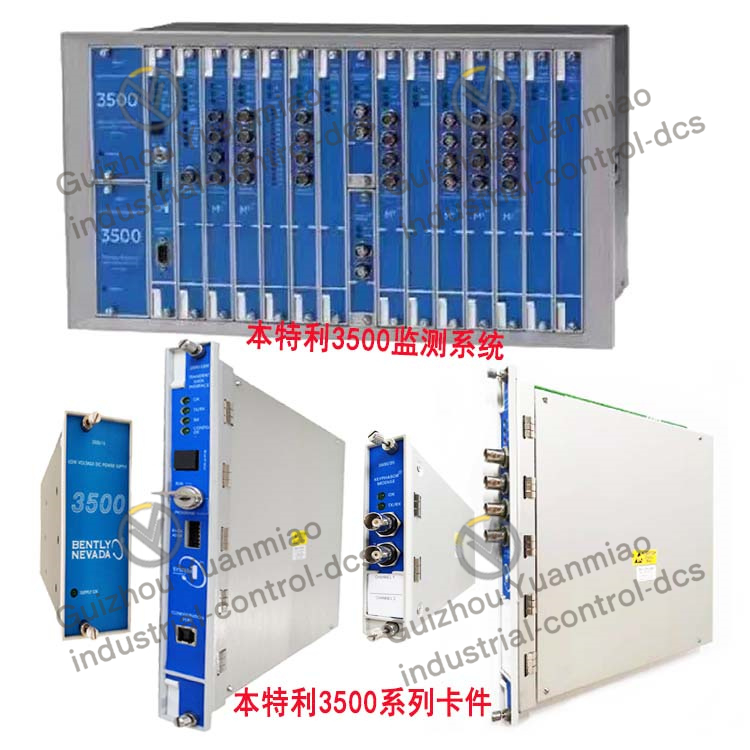
Description
Bently 3500/61-03-00 temperature Monitoring module
Input characteristics
Sensor input: Four software-configurable sensor input channels are provided. It can support 2-wire and 3-wire accelerometers, velocity sensors or short-range sensors, and can adapt to various types of sensors to meet different measurement requirements.
Temperature input: It features four temperature input channels, supporting E, J, K and T type thermocouples, as well as double-wire or three-wire RTD (thermal resistance). The support of this multi-type temperature sensor enables the module to be flexibly applied to different temperature measurement scenarios and meet the temperature monitoring requirements in various industrial environments.
Measurement range
Temperature measurement range: For thermocouple input, the measurement range varies among different types of thermocouples. For example, the measurement range of type E thermocouples is usually around -200 ℃ to 1000℃. The measurement range of Type J thermocouples is approximately from -210 ℃ to 1200℃. The measurement range of the K-type thermocouple is approximately from -270 ℃ to 1372℃. The measurement range of the T-type thermocouple is from -200 ℃ to 400℃. For RTD input, the measurement range is generally around -200 ℃ to 850℃. The specific range may vary depending on the specifications and accuracy grades of the RTD.
Output characteristics
Relay output: It features six relay outputs. Users can use the 1900 configuration software to configure the opening or closing of relay contacts based on the normal, alarm, and dangerous states of any channel or channel combination, thereby achieving control or alarm prompt functions for external devices.
Analog output: It provides four 4-20mA recorder outputs, which can offer data of any variable in any channel on any recorder output, facilitating connection with other analog input devices to achieve data transmission and recording.
Buffer output: There is a dedicated buffer output that can provide specific signal output to meet some special measurement or control requirements.
Communication characteristics
Ethernet communication: Supports Modbus communication via Ethernet, which can be conveniently connected to other devices or systems with Ethernet interfaces to achieve remote monitoring and data transmission. It can quickly and efficiently send monitoring data to the upper computer or other network devices.
Serial communication: It is equipped with software-configurable RS232/485 serial ports and also supports the Modbus communication protocol. This serial communication method is suitable for some occasions where the distance is relatively long or the communication speed requirement is not high. It can communicate with various industrial devices, enhancing the compatibility and flexibility of the module. Through the serial port, connections with DCS (Distributed Control System), SCADA (Monitoring and Data Acquisition) systems, etc. can be achieved, integrating temperature monitoring data into the entire industrial automation control system.
Reviews
There are no reviews yet.