

Description
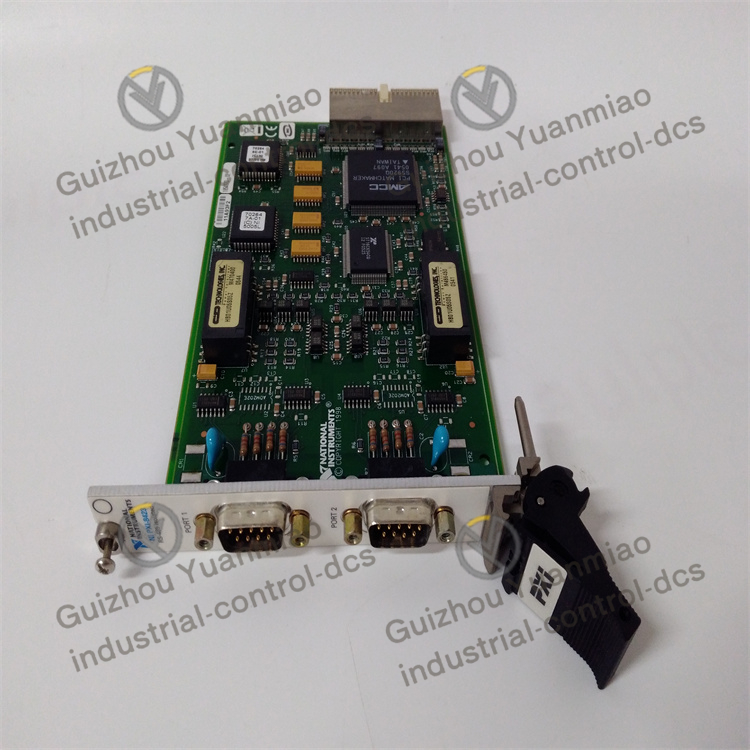
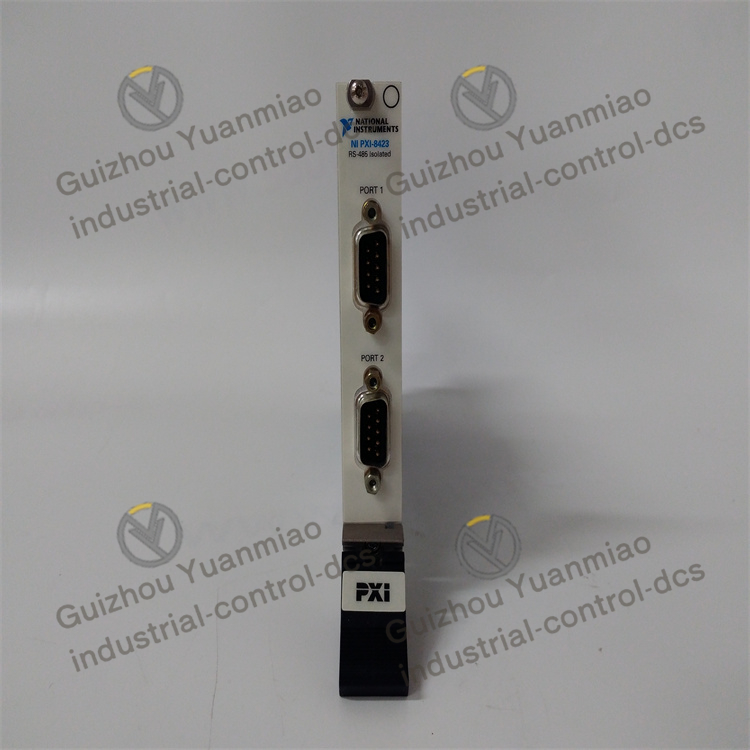
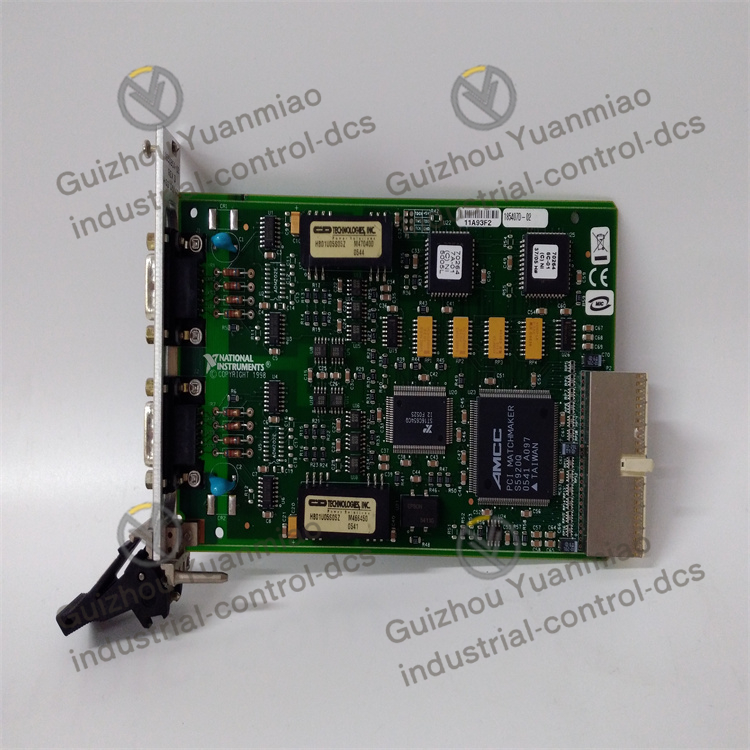
NI PXI-8423 Isolated interface module
Working principle
Core functional architecture
The PXI-8423 isolated RS485 module mainly achieves data communication and electrical isolation through the following components:
RS485 communication controller: Handles the sending and receiving of serial data, supports half-duplex communication mode, and complies with RS485 electrical standards (such as differential signal transmission, multi-point bus topology).
Isolation circuit: Transformer isolation or optocoupler isolation technology is adopted to isolate the electrical connection between the PXI system and external devices, avoiding damage to the system caused by ground loop interference and surge current.
Signal conditioning circuit: Amplifies and filters the RS485 signal to ensure signal integrity during long-distance transmission (up to approximately 1200 meters).
Data transmission mechanism
Differential signal transmission: RS485 represents logical “1” or “0” through the voltage difference between two lines (A and B), has strong anti-interference ability, and is suitable for industrial environments.
Half-duplex communication: Data can only be sent or received at the same time. The sending and receiving states can be switched through control pins (such as enable terminals). The module supports multi-node networking (up to 32 nodes on a single bus).
Baud rate adaptation and configuration: Set the baud rate (up to 2Mbps) through software (such as LabVIEW), and the internal clock circuit of the module ensures data bit synchronization.
Principle of Isolation protection
Electrical isolation implementation: The isolation layer (such as an isolation transformer) completely separates the 5V power supply of the PXI bus from the power supply of the external RS485 circuit, blocking the ground loop current (the maximum isolation voltage is usually 2500Vrms).
Surge and ESD protection: The interface end integrates TVS diodes, current-limiting resistors and other components to prevent damage to the chip caused by lightning strikes and electrostatic discharge (ESD).
Collaborative work with the PXI system
Bus communication: Exchange data with the host through the PXI backplane bus (such as PCI Express or PCI), and temporarily store data in the FIFO buffer inside the module to reduce the CPU usage rate.
Interrupt and trigger mechanism: Supports hardware interrupts (such as data reception completion, error detection), and can be synchronously triggered with other PXI modules (such as DAQ, motion control) to achieve system linkage.
Application scenarios
Industrial automation and production line monitoring
Scenario: In automotive manufacturing and electronic component production lines, it is used to connect distributed sensors (such as temperature and pressure sensors), actuators (such as solenoid valves and motor drivers), and PXI main control systems.
Case: A certain automotive assembly line uses PXI-8423 to connect 20 torque sensors to monitor the bolt tightening torque in real time. The data is transmitted back to the PXI system through the RS485 bus and combined with LabVIEW to achieve automatic alarm for non-conforming products.
Intelligent building and building control system
Scene: Connect central air conditioning controllers, elevator monitoring modules, fire alarm devices and other equipment to build a building automation network.
Case: An office building established an RS485 network through PXI-8423 to connect the temperature and humidity sensors and valve actuators of 80 rooms, achieving centralized monitoring and energy-saving control of the air conditioning system.
Monitoring of energy and power equipment
Scenario: Applied in substations, photovoltaic power stations, and energy storage systems, it collects equipment status signals (such as switch positions, voltage and current values) and transmits them to the monitoring system.
Case: A certain photovoltaic power station uses PXI-8423 to connect the RS485 interfaces of 20 inverters, collecting data such as power generation and fault codes in real time. Through the PXI system analysis, operation and maintenance reports are generated.
Medical equipment communicates with laboratory instruments
Scenario: In medical imaging equipment (such as CT, MRI) and biochemical analyzers, achieve serial data exchange among multiple devices.
Case: The laboratory department of a certain hospital uses PXI-8423 to connect blood analyzers, centrifuges and other equipment. The operation sequences of multiple instruments are synchronously controlled through the RS485 bus, and the test data are summarized to the LIS system.
Aerospace ground test system
Scene: Connecting sensors and data acquisition devices in aircraft engine test benches and spacecraft ground simulation systems.
Case: A certain aero-engine test bench is connected to 20 vibration sensors through PXI-8423, and the RS485 data is synchronously recorded with the analog quantity of the PXI-4472B dynamic signal acquisition module for engine fault prediction.
Agricultural and Environmental Monitoring Network
Scene: In smart agricultural greenhouses, weather stations, and water quality monitoring stations, a distributed sensor network is constructed.
Case: A certain smart farm uses PXI-8423 to establish an RS485 network, connecting 100 soil moisture sensors and irrigation valves, and automatically adjusts the irrigation strategy based on real-time data.
Reviews
There are no reviews yet.