


Description
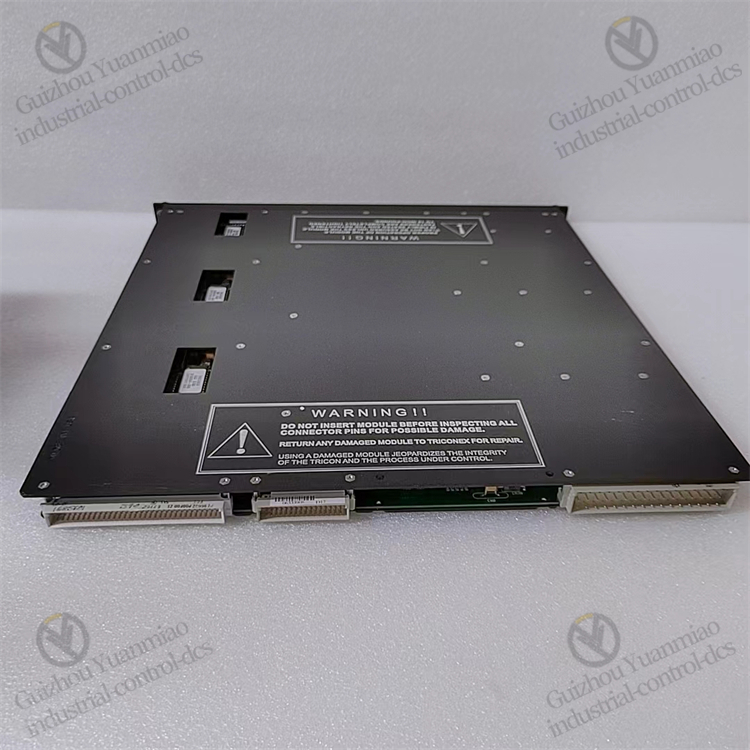
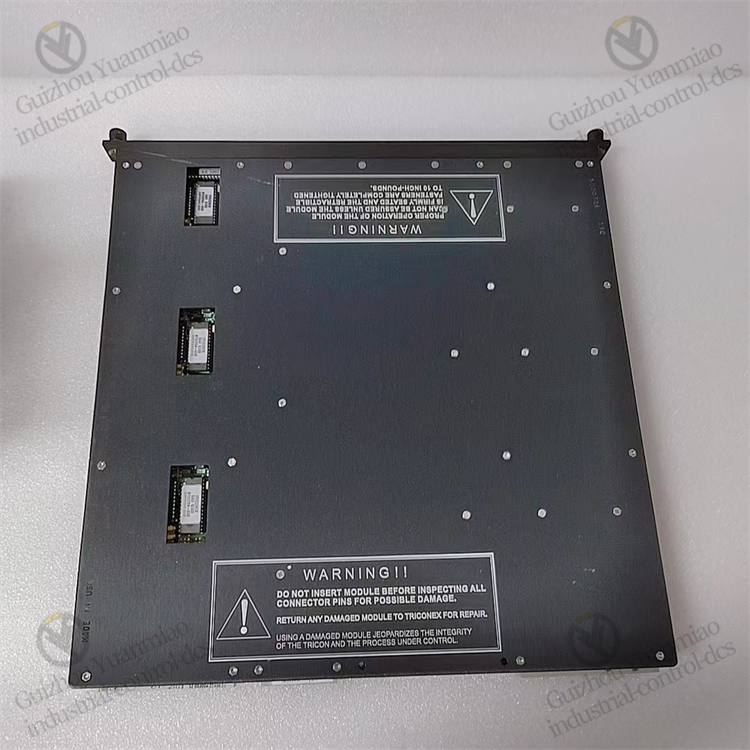
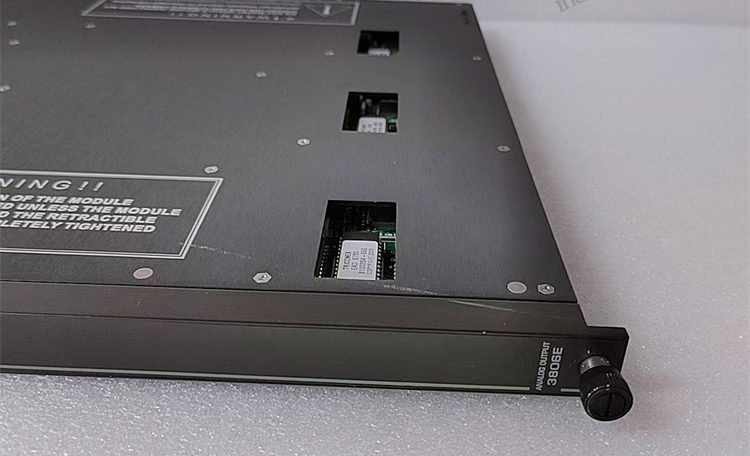
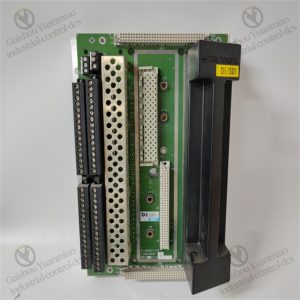
TRICONEX 3806E Analog Output Module
I. Module Positioning and Overview
The TRICONEX 3806E is a high-reliability analog output module and a core component of the TRICONEX Safety Instrumented System (SIS). Designed to comply with the SIL 3 safety integrity level, it primarily converts digital control signals into standard analog signals (such as 4-20mA current) to drive field actuators (e.g., control valves, variable frequency drives) and ensures the safety and stability of industrial control systems through redundancy mechanisms. This module is suitable for scenarios with extremely high safety and precision requirements, such as petrochemical, power, pharmaceutical, and metallurgical industries.
II. Core Features
Triple Redundancy Design (TMR)
- Adopts a three-channel independent output architecture (Channel A/B/C), with each channel equipped with independent DAC chips and power supplies. The “2 out of 3” voting mechanism (2oo3) ensures the reliability of signal output.
- When a single channel fails, the system automatically isolates the fault and maintains output through redundant channels, preventing system failure due to single-point faults.
High Precision and Stability
- Resolution: 16 bits, with output accuracy reaching ±0.05% FS (full scale), meeting precise control requirements.
- Output Signal: Supports 4-20mA current signals (standard industrial signals), compatible with most field execution devices.
- Response Time: Output update rate ≤50ms, ensuring real-time control response.
High Safety and Self-Diagnosis Capability
- Self-diagnosis coverage exceeds 99%, enabling real-time monitoring of channel faults, power anomalies, output short circuits/open circuits, etc., with alarms via LED indicators and the system bus.
- Supports the Fail-Safe mode, which can switch to preset values (such as maintaining the last valid value or outputting a safe value) during faults to prevent process 失控 (process out of control).
Industrial-Grade Environmental Adaptability
- Operating Temperature: -40°C ~ 85°C, resistant to vibration and electromagnetic interference (complying with IEC 61000 standards).
- Supports hot-swapping, allowing maintenance without shutdown and reducing production downtime.
Flexible Compatibility
- Supports docking with industrial communication protocols such as TriBus, EtherNet/IP, Modbus, and Profibus, adapting to various control systems.
- Number of Channels: Typically 8 (expandable in some models), supporting simultaneous output of multiple signals.
III. Technical Parameter Comparison (for reference with 3805E module)
| Parameter | 3806E Module | 3805E Module |
|---|---|---|
| Number of Output Channels | 8 (expandable) | 8 |
| Output Signal | 4-20mA | 4-20mA |
| Resolution | 16 bits | 12 bits |
| Output Accuracy | ±0.05% FS | <0.25% (within 4-20mA range) |
| Redundancy Design | Triple Redundancy (TMR) | Non-redundant (redundancy supported in some models) |
| Self-Diagnosis Coverage | >99% | >95% |
| Communication Protocols | TriBus, EtherNet/IP, etc. | Modbus, Profibus, etc. |
| Fail-Safe Mode | Supported (configurable safe output values) | Basic support |
IV. Working Principle Analysis
Digital Signal Processing and Conversion
- Receives digital instructions (such as control quantity data) from the controller, processes them independently through triple redundant channels, and converts them into analog current signals (4-20mA) via 16-bit DAC.
- Differential output design suppresses common-mode interference, ensuring stable signal transmission.
Redundancy Voting and Fault Handling
- The output signals of the three channels generate the final output through the “2 out of 3” voting mechanism. If the deviation of a channel exceeds the threshold (e.g., ±0.5% FS), the system automatically isolates the faulty channel and gives an alarm.
- Built-in hardware monitoring circuits real-time detect channel status (such as output short circuit, open circuit, DAC failure), triggering safe output logic during faults.
Signal Conditioning and Protection
- Output signals are filtered and power-amplified by hardware to adapt to the driving requirements of field actuators.
- Equipped with overrange protection (e.g., withstand +42.5VDC voltage) and overcurrent protection to prevent module damage from external faults.
Communication and Control Interfaces
- Interacts with the controller via the TriBus high-speed bus, supports industrial protocols for communication with the host computer, and enables real-time reading of module status and configuration parameters.

V. Typical Application Scenarios
Petrochemical Industry
- Reactor Control: Outputs analog signals to adjust feed valve opening and heating power, precisely controlling reaction temperature and pressure to avoid safety accidents such as polymerization.
- Distillation Column Optimization: Controls reflux ratio and reboiler heating quantity to ensure product component purity and improve process efficiency.
Power and Energy Industry
- Generator Set Speed Regulation: Outputs signals to control turbine governors, maintaining grid frequency stability; adjusts excitation current to stabilize generator voltage.
- Boiler Combustion Control: Controls fuel valve and air supply valve opening to optimize air-fuel ratio, improve combustion efficiency, and reduce pollutant emissions.
Pharmaceutical and Food Processing
- Clean Workshop Control: Adjusts air valves and humidifiers in air conditioning systems to precisely control temperature, humidity, and pressure difference, meeting GMP standards.
- Reactor Process Control: Controls stirring speed and material addition to ensure consistency in drug synthesis or food processing.
Metallurgy and Manufacturing Industry
- Blast Furnace Ironmaking: Controls hot blast stove combustion valve opening to adjust hot air temperature and pressure, optimizing molten iron quality.
- Extruder Production Line: Adjusts motor speed and heating temperature to ensure the extrusion accuracy and stability of plastic profiles.
Nuclear Energy and Safety Systems
- Nuclear Reactor Cooling Control: Outputs signals to adjust the flow rate of coolant pumps and valve opening, maintaining safe core temperature.
- Safety Interlock Execution: In emergency situations, quickly closes key equipment (such as isolation valves) through module output signals to prevent accidents from expanding.

Reviews
There are no reviews yet.