

Description
TRICONEX 8311N Safety Controller Module
I. Module Positioning and Core Functions
The TRICONEX 8311N is a safety controller module based on Triple Module Redundancy (TMR) technology, serving as a core component of the Industrial Safety Instrumented System (SIS). It primarily executes safety logic control, fault diagnosis, and real-time data processing. Designed in compliance with IEC 61508/61511 standards, it meets the SIL 3 safety integrity level, suitable for industrial scenarios with extremely high safety requirements, such as petrochemical, nuclear power, and natural gas industries.
II. Hardware Architecture and TMR Technology Implementation
Triple Redundancy Core Design
- Adopts a physically independent three-channel (A/B/C) architecture, with each channel containing independent processors (e.g., high-performance microcontrollers), memory, communication interfaces, and power modules to achieve electrical and fault isolation.
- Each channel processes input signals in parallel, performing real-time “2 out of 3 voting” via the internal high-speed bus (TriBus) to ensure reliable system operation in the event of single-point failures.
Key Hardware Features
- Processor Performance: Each channel is equipped with a 32-bit or 64-bit processor with a clock speed reaching hundreds of megahertz, supporting millisecond-level logic operations and data processing to meet real-time control requirements.
- Storage Configuration: Each channel has independent RAM, Flash, and non-volatile memory (e.g., EEPROM) for program operation, data storage, and power failure protection.
- Communication Interfaces: Integrates multiple industrial communication interfaces (e.g., Ethernet, serial ports, dedicated safety buses), supporting triple redundant communication links to ensure reliable connection with sensors, actuators, and host computers.
- Hardware Diagnosis Mechanism: Built-in watchdog timer, power monitoring circuit, and channel health detection logic continuously monitor hardware faults (e.g., chip anomalies, communication interruptions), with a diagnostic coverage rate exceeding 99%.
III. Functional Characteristics and Technical Advantages
Safety Logic Control Capability
- Supports custom safety logic programming through dedicated software (e.g., TriStation) using programming languages such as Ladder Diagram (LD) and Function Block Diagram (FBD), enabling configuration of safety functions like Emergency Shutdown (ESD), Fire & Gas (F&G) alarm, and process interlock.
- Features high-speed input/output processing, supporting redundant acquisition and output of digital and analog signals with a response time ≤1ms, meeting the real-time requirements of safety interlocks.
High Availability and Fault Tolerance Mechanism
- Hot Redundancy and Dynamic Reconfiguration: Supports hot-swapping replacement of faulty channels. New modules automatically synchronize data and join voting without shutdown. When a single channel fails, the system automatically switches to dual-machine hot standby mode to maintain control functions.
- Fault Masking and Alarm: When data from one channel disagrees with others, the faulty channel is automatically masked, and alarms are triggered via LED indicators and system logs, while recording fault types (e.g., hardware errors, data check failures).
Industrial Environmental Adaptability
- Wide Temperature and Anti-Interference Design: Operates in the temperature range of -40°C to 85°C, withstands strong vibrations (e.g., 50G impact) and high electromagnetic interference (EMI). Optocoupler/magnetic isolation technology prevents external interference from affecting data transmission.
- Certification Compliance: Passes international safety certifications such as SIL3, ATEX, and CSA, meeting application requirements for hazardous areas (e.g., Zone 1/21).
IV. Communication and Integration Capability
Multi-Protocol Support
- Embedded industrial communication protocol stack supports standard protocols like Modbus, EtherNet/IP, Profinet, and HART, enabling seamless integration with DCS, PLC, and third-party devices.
- Dedicated safety communication bus (e.g., TriBus) achieves three-channel data synchronization and voting. Redundant communication bandwidth design ensures data transmission efficiency remains unaffected by single-point failures.
System Expansion and Networking
- Can form redundant control systems with other TRICONEX modules (e.g., I/O modules, communication modules), supporting distributed architecture and control scale expansion via redundant networks (e.g., dual ring networks).
- Supports communication with host monitoring systems (e.g., SCADA), real-time uploading of device status, fault information, and control data for remote operation and maintenance.
V. Typical Application Scenarios
Petrochemical Safety Systems
- Used for pressure/temperature safety interlock control of reactors and storage tanks. When abnormal signals are detected, the triple redundant logic of 8311N quickly triggers emergency shut-off valves to prevent leakage or explosion accidents.
Nuclear Power I&C Systems
- As a safety-level controller for nuclear reactors, it connects sensors with control rod drive systems, ensuring reliable execution of shutdown commands in radioactive environments and meeting nuclear safety regulations for fault tolerance.
Natural Gas Processing Plants
- Monitors flow and pressure of compressors and pipelines. Through the redundant logic of 8311N, it processes fault signals, automatically activating pressure relief devices or shutting down equipment to avoid overpressure risks.
Safety Protection in High-End Manufacturing
- In automated production lines, controls safety emergency stop logic for robotic arms and robots. When a communication channel is affected by electromagnetic interference, redundant channels ensure emergency stop signals are not lost, safeguarding personnel and equipment.
VI. Comparative Advantages over Similar Products
| Characteristics | TRICONEX 8311N | Traditional Dual-Machine Hot Standby Controllers | Non-Redundant Controllers |
|---|---|---|---|
| Redundancy Architecture | Triple Module Redundancy (TMR), 2 out of 3 voting | Dual-machine master-slave with fault switching | Single-channel without redundancy |
| Safety Level | SIL 3 | Up to SIL 2 | No safety certification |
| Fault Tolerance | Supports 1-channel failure without affecting functionality | Supports 1-machine failure with brief switching interruption | Single-point failure leads to system failure |
| Real-time Performance | Data processing delay ≤1ms | Switching delay ≥10ms | No redundancy guarantee |
| Application Scenarios | High-risk industries (nuclear power, petrochemicals) | Medium-low risk scenarios | Non-safety-critical scenarios |
VII. Operation, Maintenance, and Configuration Key Points
Software Tool Support
- Uses TriStation programming software for logic configuration, fault diagnosis, and online monitoring, supporting visual channel status display and voting strategy adjustment (e.g., strict 2 out of 3 or fault tolerance priority).
- Supports generating codes that meet functional safety requirements through safety configuration tools, ensuring traceability and compliance of logic design.
Maintenance and Diagnosis
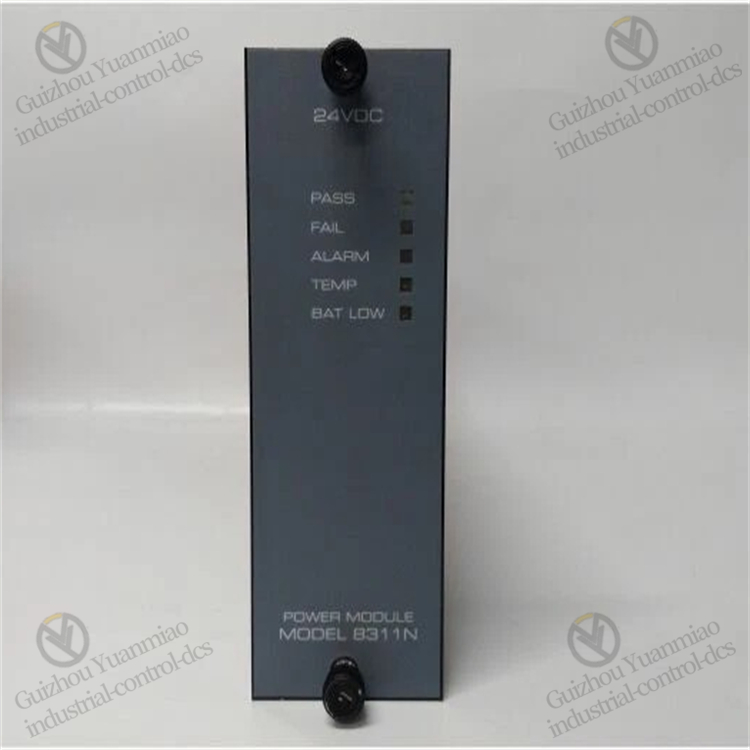
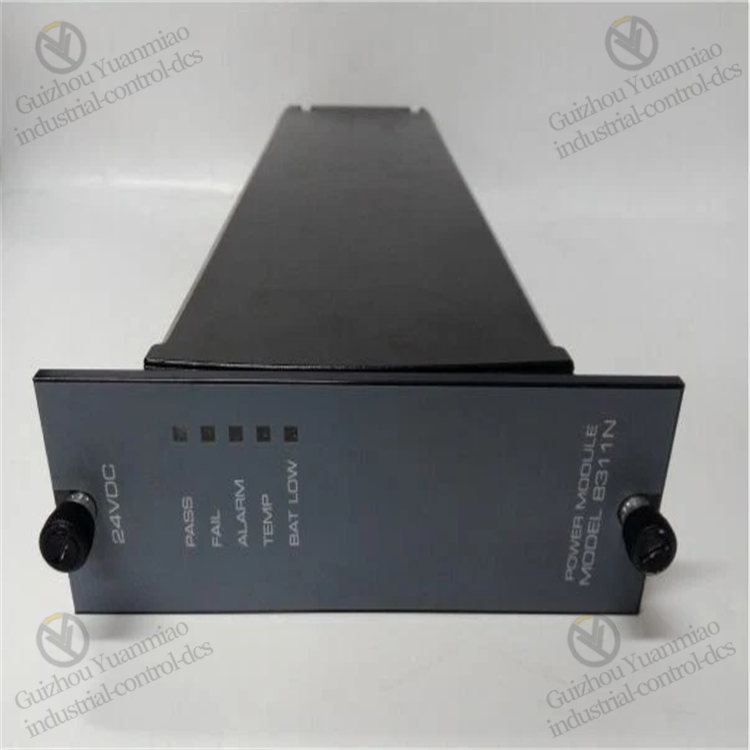
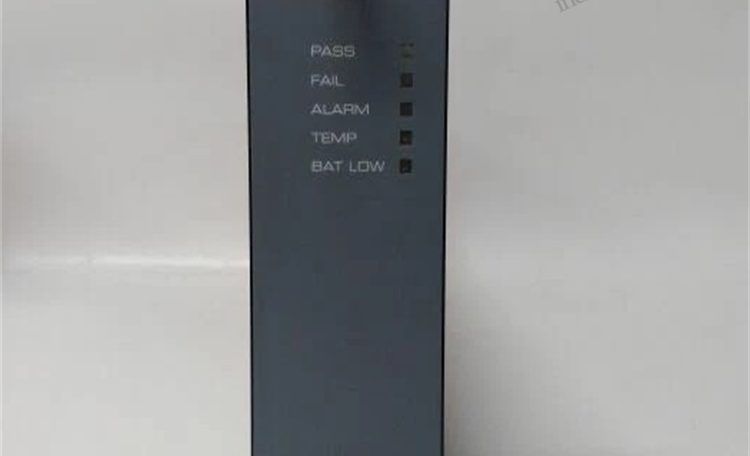
- The module panel integrates multiple groups of LED indicators (e.g., channel status, fault, communication) for quick on-site problem 定位 (fault location). System logs record fault history to support remote maintenance analysis.
- Regularly performs online self-diagnosis tests (e.g., channel voting function test, hardware health check) to ensure the effectiveness of redundancy mechanisms.
VIII. Conclusion: Core Value of 8311N for Industrial Safety
The TRICONEX 8311N safety controller module achieves the design goal of “fail-safe” through deep integration of TMR technology and hardware/software, eliminating single-point failure risks from the underlying architecture. Its high reliability, real-time performance, and environmental adaptability make it a core component of safety control in key industrial fields, providing solid technical guarantees for the continuous operation of process industries, personnel safety, and equipment protection. In the context of Industry 4.0 and smart manufacturing trends, the 8311N serves as a vital node connecting safety systems with digital platforms, promoting the integrated integration of safety control and production management.
Reviews
There are no reviews yet.