

Description
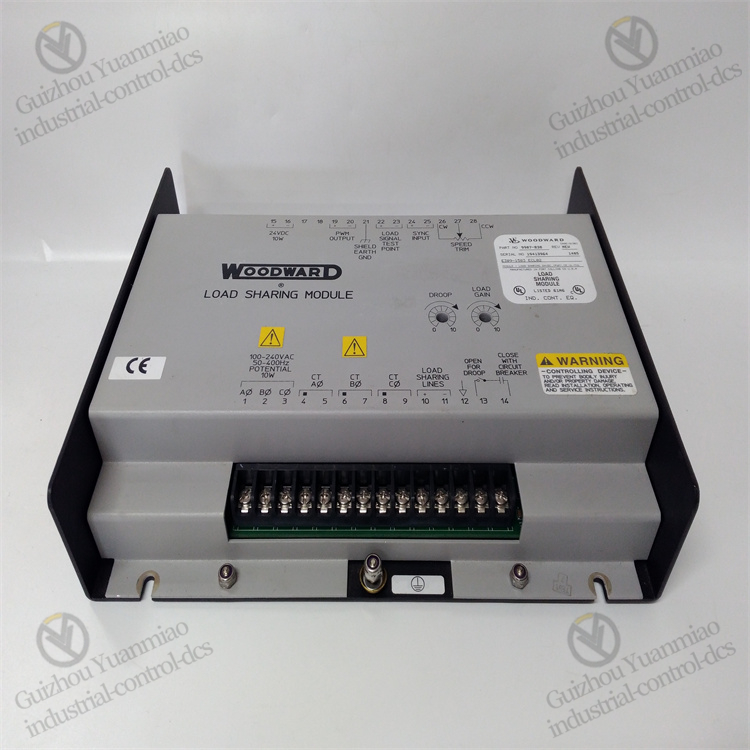
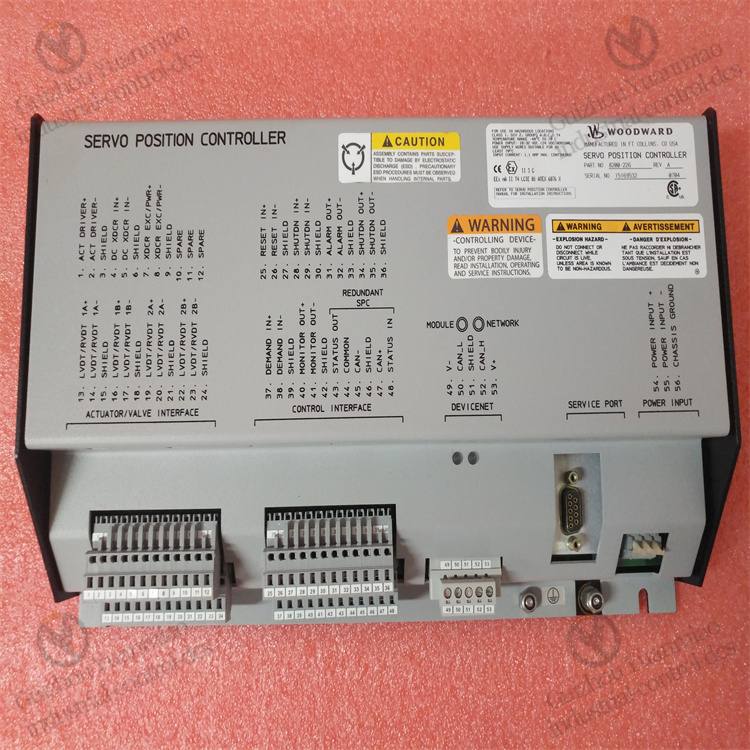
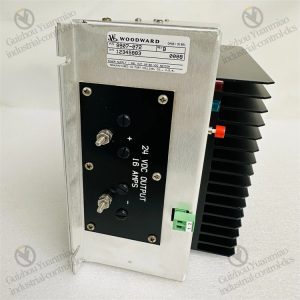
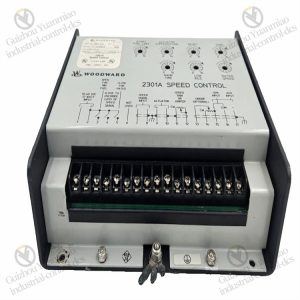
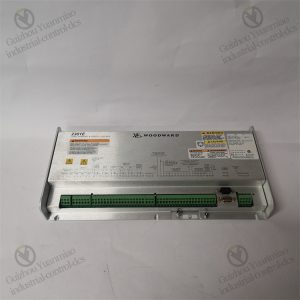
Woodward 9907-806 governor electro-hydraulic converter
Working principle
I. Core Functions and Signal Conversion Logic
Electrical signal input and processing
Receive standard electrical signals (presumed to be 4-20mA current signals or 0-10V voltage signals) from controllers (such as Woodward 505E governors, MicroNet systems), which represent control instructions for rotational speed or load.
The internal circuit amplifies, filters and other processes the input electrical signal to ensure the stability and accuracy of the signal and avoid control deviations caused by interference.
Electricity-mechanical conversion
By using the electromagnetic principle, the processed electrical signal is converted into mechanical displacement. For instance, when the input current signal passes through the coil, an electromagnetic force is generated, driving the internal armature or valve core to produce a linear displacement. The amount of this displacement is proportional to the input electrical signal.
Mechanical-hydraulic conversion
The mechanical displacement of the armature or the valve core further acts on the hydraulic system:
When the valve core moves, it will change the flow path of the hydraulic oil or the opening area, thereby regulating the output hydraulic pressure.
For example, the greater the opening degree of the valve core, the more hydraulic oil passes through and the higher the output pressure. Conversely, the lower the pressure, the eventually the hydraulic signal (pressure or flow rate) will be proportional to the input electrical signal.
Ii. Key Components and Workflow
1. Main components
Electromagnetic coil: Receives electrical signals and generates electromagnetic force to drive the actuator.
Armature/valve core assembly: It generates mechanical displacement under the action of electromagnetic force and serves as the core component for electro-mechanical conversion.
Hydraulic valve assembly: It includes an oil inlet, an oil outlet and an oil return port, and controls the flow direction and volume of hydraulic oil through the displacement of the valve core.
Feedback mechanism: Through mechanical connecting rods or sensors (such as displacement sensors), the position of the valve core is fed back to the input circuit to form a closed-loop control, ensuring the accuracy of the output hydraulic signal (i.e., “electro-mechanical-hydraulic” closed-loop regulation).
2. Workflow example
plaintext
The controller sends a speed adjustment electrical signal (such as increasing the current) → the current in the electromagnetic coil increases → the electromagnetic force strengthens → the armature drives the valve core to move → the opening of the hydraulic valve increases → the output pressure of the hydraulic oil rises → it pushes the servo cylinder (such as the steam turbine intake valve) to act → the steam intake volume is adjusted to change the speed.
Meanwhile, the feedback mechanism returns the actual displacement signal of the valve core to the input circuit, compares it with the target electrical signal, corrects the deviation, and ensures that the hydraulic output strictly matches the electrical signal.
Iii. Coordinated operation with the speed regulation system
Take the steam turbine speed regulation system as an example:
Rotational speed detection and electrical signal generation
The rotational speed sensor (such as a magnetoresistive probe) detects the rotational speed of the steam turbine in real time. After comparing it with the set value, the controller (such as Woodward 505E) generates a regulating electrical signal (output a larger current if speed increase is required).
Electro-hydraulic conversion and hydraulic execution
The 9907-806 receives electrical signals and converts them into hydraulic pressure, driving the servo cylinder to increase the opening degree of the steam inlet valve, increase the steam flow rate, and raise the steam turbine speed to the set value.
Closed-loop regulation and stable control
When the rotational speed reaches the target value, the controller reduces the electrical signal output. The output hydraulic pressure of 9907-806 drops, and the opening degree of the steam inlet valve is adjusted back, forming a closed-loop control of “detection – conversion – execution – feedback” to ensure the stability of the rotational speed.
Iv. Technical Features and Design Advantages
High-precision proportional conversion: Through multi-level conversion from electromagnetic to mechanical to hydraulic, a linear proportional relationship between electrical signals and hydraulic signals is achieved, and the control accuracy can reach within ±0.5%.
Rapid response capability: millisecond-level response speed (typically < 100ms), meeting the rapid regulation requirements for sudden speed changes in equipment such as steam turbines.
Anti-interference design: The internal circuit and hydraulic oil circuit have filtering and pressure stabilizing functions, which can resist electromagnetic interference and hydraulic fluctuations in industrial environments.
Compatibility and scalability: It can be seamlessly integrated with Woodward series controllers and is compatible with turbine and generator systems of different power levels.

V. Principle Manifestation in Application Scenarios
Steam turbine speed regulation: When the load of the power grid changes, causing fluctuations in the steam turbine speed, the 9907-806 regulates the steam intake volume through electro-hydraulic conversion to maintain a stable speed.
Generator load distribution: When used in conjunction with load sharing modules (such as 9907-252), the electro-hydraulic converter adjusts the hydraulic pressure based on the load electrical signal to control the generator throttle or steam valve, achieving load balancing when multiple generators are connected in parallel.
Summary
The working principle of Woodward 9907-806 is essentially through the closed-loop conversion of “electricity – mechanics – hydraulics”, precisely mapping the electrical signals of the controller to the hydraulic execution actions, thereby achieving the regulation of the rotational speed or load of power equipment (such as turbines, engines). Its core advantages lie in high precision, fast response and deep integration with the Woodward control system. For more detailed technical information, it is recommended to refer to the product manual or consult the official technical support.
Reviews
There are no reviews yet.