

Description
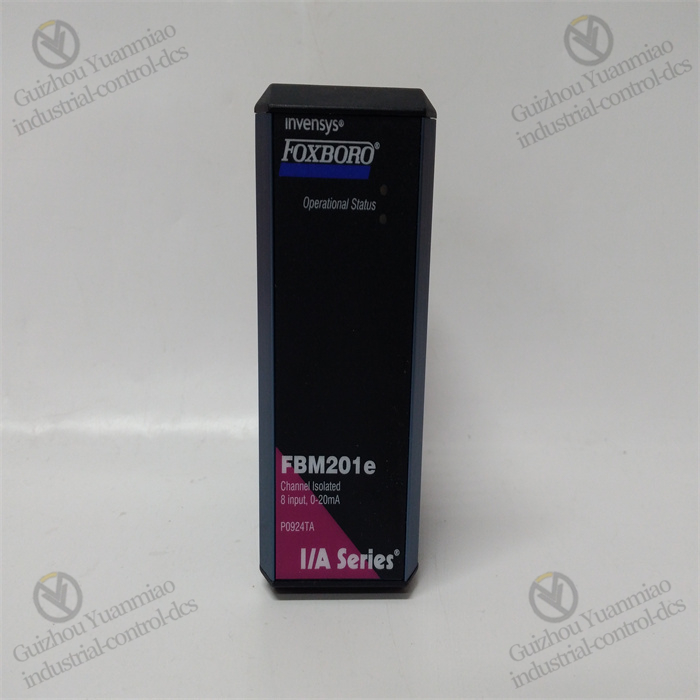
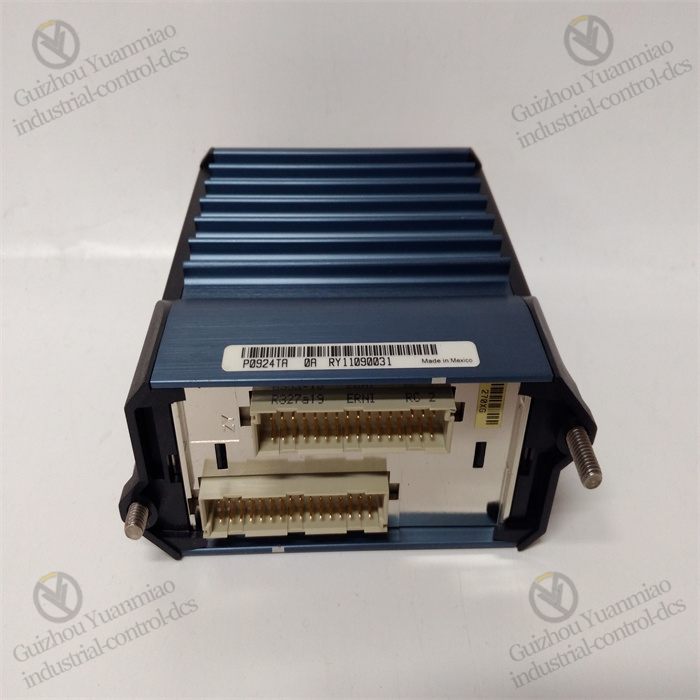
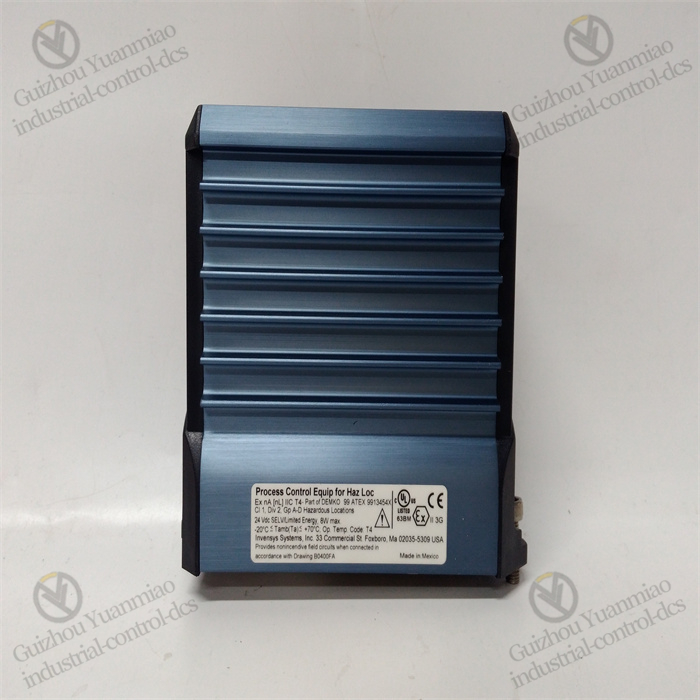
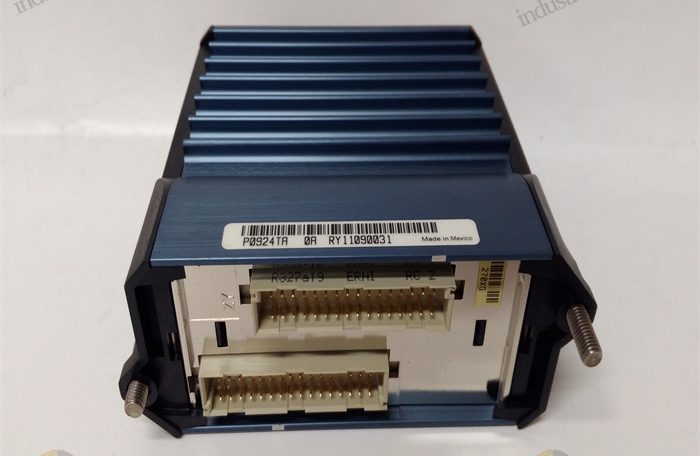
FOXBORO FBM201E Analog Input Interface module
FOXBORO FBM201E is an analog input interface module. As a key component of DCS (Distributed Control System), its working principle mainly involves four core links: signal acquisition, processing, conversion and communication.
- Signal Acquisition
The FBM201E receives analog signals from on-site sensors through its multi-channel input interface (usually 8 independent channels). These signals can be:
- Current signals (such as 4-20mA, 0-20mA)
- Voltage signals (such as 0-10V, ±5V, ±10V)
- Resistance signals (such as resistance changes of RTD temperature sensors)
- Special signals (such as millivolt-level temperature difference signals of thermocouples)
Each channel is equipped with electrical isolation function (usually using photoelectric isolation or transformer isolation), which can effectively prevent interference between channels and the influence of ground loops, ensuring the purity of the signal.
- Signal Conditioning
The collected original analog signals usually need preprocessing to meet the requirements of subsequent A/D conversion:
- Signal amplification: Adjust the gain for weak signals (such as thermocouples).
- Filtering: Remove high-frequency noise and power supply interference through hardware filters (such as RC filters, digital filters).
- Linearization processing: Perform mathematical compensation on nonlinear signals (such as the resistance-temperature curve of RTD).
- Range conversion: Normalize input signals of different ranges to the effective input range of the A/D converter.
- A/D Conversion
The FBM201E adopts Sigma-Delta modulation technology to achieve high-precision analog-to-digital conversion:
- Oversampling: Sample at a rate much higher than the Nyquist frequency to reduce quantization noise.
- Digital filtering: Improve the effective number of bits (usually 16-24 bits) through a digital decimation filter.
- Integration period: Configurable integration time (such as 20ms corresponding to 50Hz power frequency suppression) to eliminate power frequency interference.
- Conversion accuracy: The typical accuracy is ±0.03% FS (full scale), and the temperature coefficient is as low as ±50ppm/°C.
- Digital Signal Processing
The converted digital signals are processed by the internal processor of the module as follows:
- Calibration compensation: Apply factory calibration parameters to correct zero, range, and linear errors.
- Alarm judgment: Compare the measured value with the preset high and low limit thresholds in real time to trigger alarm output.
- Rate of change limitation: Suppress sudden change signals to prevent misoperation caused by interference.
- Data formatting: Convert the original values into engineering units (such as °C, MPa, m³/h).
- Communication and Integration
The processed data is transmitted to the DCS controller through fieldbus protocols (such as FOXBORO’s I/A Series system bus):
- Redundant communication: Supports dual redundant buses to ensure the reliability of data transmission.
- Status feedback: The module uploads its working status in real time (such as power failure, channel abnormality).
- Remote configuration: Sampling rate, filtering parameters and other configurations can be modified remotely through upper computer software.
- Power Supply and Safety Mechanism
- Isolated power supply: The module uses an isolated DC/DC converter internally to ensure the separation of power supply and signal ground.
- Overvoltage/overcurrent protection: Each channel has a built-in current-limiting resistor and TVS (transient voltage suppressor diode) to prevent damage from surges.
- Fail-safe design: When a power failure or communication interruption is detected, the module can output a safe value according to a preset strategy (such as maintaining the last value, outputting an alarm value).
Typical Application Scenarios
The FBM201E is often used in industrial scenarios that require high-precision analog acquisition, such as:
The FBM201E is often used in industrial scenarios that require high-precision analog acquisition, such as:
- Temperature/pressure monitoring: Connecting thermocouples, RTDs or pressure transmitters.
- Flow/liquid level measurement: Collecting signals from flowmeters or liquid level meters with 4-20mA output.
- Environmental parameter monitoring: Such as the acquisition of sensor signals like pH value and conductivity.
Summary
The FBM201E converts on-site analog signals into reliable digital quantities through a complete chain of isolated acquisition → signal conditioning → high-precision A/D conversion → digital processing → communication transmission, providing an accurate data foundation for industrial control systems. Its core advantages lie in high isolation, anti-interference ability and configurability, making it suitable for long-term stable operation in complex industrial environments.
The FBM201E converts on-site analog signals into reliable digital quantities through a complete chain of isolated acquisition → signal conditioning → high-precision A/D conversion → digital processing → communication transmission, providing an accurate data foundation for industrial control systems. Its core advantages lie in high isolation, anti-interference ability and configurability, making it suitable for long-term stable operation in complex industrial environments.
Reviews
There are no reviews yet.