

Description
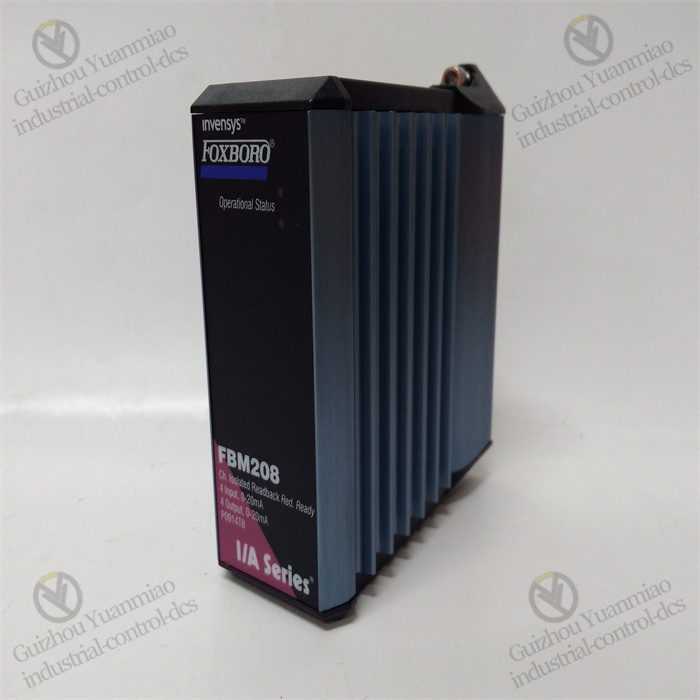
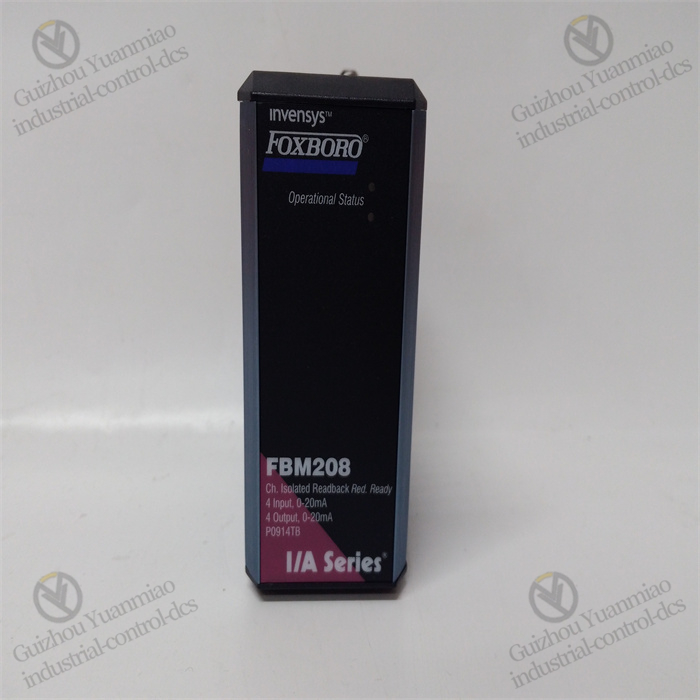
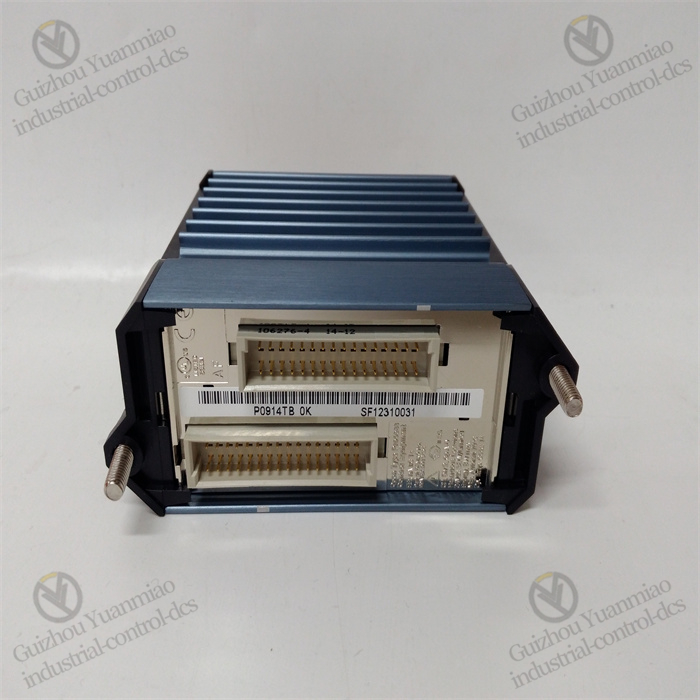
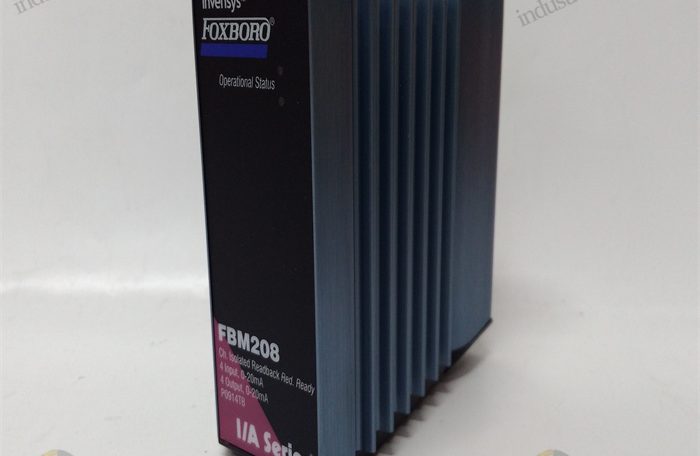
FOXBORO FBM208 8-channel input/output interface component
FOXBORO FBM208 is an 8-channel 0-20mA input/output interface module with output readback redundancy, featuring redundant 4AI/4AO functions. The following is an introduction to its working principle:
Signal Input Processing
- Analog signal acquisition: It can receive 0-20mA analog signals from on-site equipment, such as signals output by temperature sensors, pressure sensors, etc. Through its internal signal conditioning circuit, the input analog signals are amplified, filtered, and other processed to ensure the accuracy and stability of the signals. Then, the processed signals are transmitted to the analog-to-digital conversion (ADC) circuit to convert the analog signals into digital signals for subsequent processing by the microprocessor.
- Digital signal processing: It can also process some input information related to digital quantities. It decodes and verifies the input digital signals to obtain accurate digital information, which is stored in the corresponding registers for system program calls.
Signal Output Principle
- Digital-to-analog conversion: When it is necessary to output analog signals, the microprocessor sends the digital signals stored in the registers to the digital-to-analog conversion (DAC) circuit according to the control instructions. The DAC circuit converts the digital signals into corresponding 0-20mA analog signals, and then outputs the analog signals to on-site equipment through the output drive circuit, thereby realizing the control of on-site equipment, such as controlling the opening of control valves.
- Output readback function: The FBM208 has an output readback function. After outputting the analog signal, it samples the signal at the output end through a specific circuit, converts it into a digital signal, and reads it back to the microprocessor. The microprocessor compares the read-back signal with the original output signal to determine whether the output channel is working normally. If a large deviation between the two is found, it is judged that the channel may be faulty, and corresponding measures are taken, such as sending an alarm signal.
Redundancy Function Implementation
As a module with redundancy function, the FBM208 can usually be used in conjunction with another identical module to achieve redundant backup. Among the two modules, one serves as the master module and the other as the tracker module. Under normal circumstances, the master module is responsible for processing input and output signals and other main tasks, while the tracker module tracks the status of the master module in real-time and maintains consistent parameters and data with the master module. When the master module fails, the tracker module will automatically take over the work of the master module and continue to output correct signals to on-site equipment, ensuring the stable operation of the system without control interruption due to the failure of a certain module.
As a module with redundancy function, the FBM208 can usually be used in conjunction with another identical module to achieve redundant backup. Among the two modules, one serves as the master module and the other as the tracker module. Under normal circumstances, the master module is responsible for processing input and output signals and other main tasks, while the tracker module tracks the status of the master module in real-time and maintains consistent parameters and data with the master module. When the master module fails, the tracker module will automatically take over the work of the master module and continue to output correct signals to on-site equipment, ensuring the stable operation of the system without control interruption due to the failure of a certain module.
Communication and Control Principle
The FBM208 can communicate with other devices of the Distributed Control System (DCS) through the fieldbus. It follows relevant communication protocols, sends the collected input signal data to the control processor of the DCS, and receives control instructions sent by the control processor to control the output signals. During communication, data encoding, decoding, verification, and other operations are performed to ensure the accuracy and reliability of data transmission. In addition, the module also supports certain programming and configuration functions. Users can set the parameters of the module through relevant software according to actual industrial control needs, such as the range of output signals and alarm thresholds, to adapt to different application scenarios.
The FBM208 can communicate with other devices of the Distributed Control System (DCS) through the fieldbus. It follows relevant communication protocols, sends the collected input signal data to the control processor of the DCS, and receives control instructions sent by the control processor to control the output signals. During communication, data encoding, decoding, verification, and other operations are performed to ensure the accuracy and reliability of data transmission. In addition, the module also supports certain programming and configuration functions. Users can set the parameters of the module through relevant software according to actual industrial control needs, such as the range of output signals and alarm thresholds, to adapt to different application scenarios.
The core performance characteristics are as follows:
- High-precision analog processing
- 8-channel independent I/O: Integrates 8 independent analog input/output channels, which can simultaneously process signals from multiple sensors (such as pressure, temperature, flow transmitters) and actuators (such as control valves, frequency converters).
- 0-20mA standard signal: Supports the industrial standard 0-20mA current signal, compatible with mainstream sensors and actuators, without the need for additional signal conversion.
- High-resolution conversion: Uses high-precision ADC/DAC (analog-to-digital/digital-to-analog converters), usually providing 16-bit or higher resolution to ensure signal conversion accuracy (typical accuracy ±0.01%~±0.1%).
- Wide range adaptability: Can be configured to receive or output current signals in different ranges such as 0-20mA and 4-20mA, meeting the needs of diverse industrial scenarios.
- Output readback and redundancy design
- Output readback function: Each output channel is equipped with an independent readback circuit to monitor the actual value of the output signal in real-time and compare it with the set value to achieve closed-loop verification. If a deviation exceeding the threshold is detected (such as disconnection or short circuit), an alarm is triggered immediately or it is automatically switched to the backup channel.
- Redundant configuration: Supports dual-module redundancy (hot standby). The main and standby modules work synchronously. When the main module fails, it seamlessly switches to the standby module to ensure the continuity of the control system (such as critical scenarios in chemical industry, electric power, etc.).
- Electrical isolation and anti-interference ability
- Isolation between channels: Each input/output channel is isolated by optocoupler or magnetic coupler (typical isolation voltage ≥1500V AC) to prevent signal interference between channels and improve system stability.
- EMC protection: Passes industrial-grade electromagnetic compatibility (EMC) certification, can resist strong electromagnetic interference (such as motor startup, radio frequency radiation), and is suitable for complex industrial environments.
- Surge protection: Built-in surge suppression circuit, can withstand ±250V transient voltage impact, reducing the risk of damage caused by lightning strikes or power fluctuations.
- Flexible configuration and communication integration
- Software programmable: Supports configuring channel parameters (such as signal type, range, filter time) through DCS system software (such as Foxboro I/A Series) without hardware modifications.
- Communication protocol support: Compatible with mainstream industrial communication protocols (such as Modbus RTU/TCP, FOUNDATION Fieldbus), and can be seamlessly connected to Distributed Control System (DCS) or SCADA system.
- Diagnosis and alarm: Provides real-time channel status monitoring (such as open circuit, short circuit, overrange), and feeds back fault information through LED indicators or system logs, simplifying the maintenance process.
- Industrial-grade reliability and environmental adaptability
- Wide temperature working range: -40°C ~ +70°C, adapting to harsh industrial environments (such as deserts, polar regions, etc.).
- Low power consumption design: The power consumption of a single module is usually ≤10W, supporting redundant power supply (dual 24V DC input), reducing system energy consumption.
- Modular structure: Adopts DIN rail installation, supports hot swapping, facilitating quick replacement of faulty modules and reducing downtime.
- High MTBF (Mean Time Between Failures): Typical value ≥50,000 hours, meets IEC 61508 functional safety standards, and is suitable for safety-critical applications.
- Expansion of application scenarios
- Process control: In industries such as chemical industry, electric power, and metallurgy, it precisely controls continuous variables such as flow, pressure, and temperature.
- Safety interlock: Cooperates with the emergency shutdown system (ESD) to realize redundant control of key equipment and ensure safe production.
- Smart factory: As an edge layer device, it digitizes on-site signals and uploads them to the Industrial Internet of Things (IIoT) platform to support data analysis and predictive maintenance.


Reviews
There are no reviews yet.