



Description
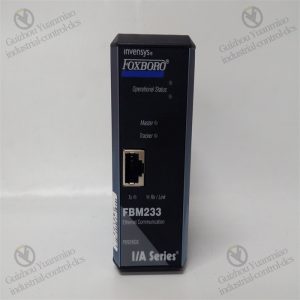
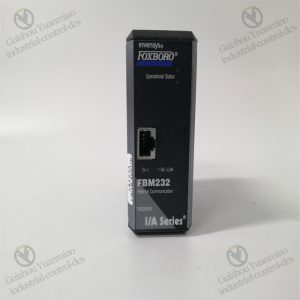
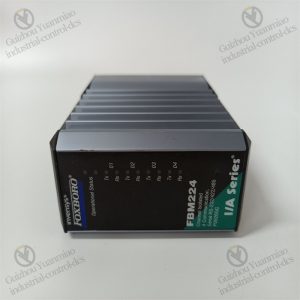
Foxboro FBM231 Field Equipment System Integrator (FDSI) module
Foxboro FBM231, as a Field Device System Integrator (FDSI) module, operates based on the principle of enabling efficient data interaction and integration between field devices and the Foxboro I/A Series control system. The core functionality revolves around data collection, transmission, processing, and command execution through standardized communication protocols and hardware interfaces. The operational process can be broken down into the following key stages:
-
Communication Interface and Protocol Adaptation
The FBM231 supports multiple serial communication interfaces (e.g., RS-232, RS-422, RS-485) and is compatible with mainstream industrial protocols such as Modbus.- When connecting to field devices (e.g., sensors, transmitters, actuators), the module preconfigures communication parameters (interface type, baud rate, parity, etc.) via software tools to ensure stable connections.
- For example, when interfacing with a pressure transmitter using Modbus RTU, the FBM231 parses data packets to extract pressure values and formats control system commands (e.g., valve adjustment) for device execution.
-
Data Collection and Processing
- Data Collection: The module scans connected devices in real-time via serial interfaces, reading status data (e.g., temperature, level, switch positions) at configurable intervals (500ms–255s). It supports various data types, including analog (integer/floating-point) and digital (single or packed binary values).
- Data Processing: Collected data undergoes preliminary checks (integrity verification, format conversion) to ensure accuracy. For instance, converting a 4–20mA current signal from an analog sensor into a readable physical value (e.g., 0–100°C).
-
Interaction with the Control System
The FBM231 connects to the Foxboro I/A Series control system via a fieldbus (e.g., redundant 2Mbps module bus) for bidirectional data flow:- Data Upload: Processed field device data is transmitted to the control system’s database for monitoring, logging, or control logic.
- Command Execution: Control system commands (e.g., starting a pump) are sent to the FBM231, which converts them into device-specific signals (e.g., Modbus write commands).
-
Redundancy and Reliability Assurance
- The module supports redundant fieldbus connections (Paths A and B), automatically switching between paths in case of failure to ensure uninterrupted communication.
- Rugged hardware design with EMI protection and wide-temperature operation (compliant with industrial standards) ensures stable performance in harsh environments (e.g., chemical plants, metal processing).
-
Configuration and Management
Users configure the FBM231 via Foxboro’s dedicated software (Windows/Solaris-based) to set parameters such as:- Communication interface types, device addresses, scan rates, and data point mappings (linking field device parameters to database entries).
- The software validates settings (e.g., baud rate limits, address conflicts) to prevent configuration errors.
Summary
The FBM231 functions as a “bridge” between field devices and control systems:
The FBM231 functions as a “bridge” between field devices and control systems:
- It communicates with field devices via serial interfaces for data collection and command execution.
- It integrates with the control system via fieldbus for centralized monitoring and remote control.
- Redundancy and industrial-grade hardware ensure reliable communication, meeting the demands of industrial automation for centralized management of distributed devices.
Reviews
There are no reviews yet.