

Description
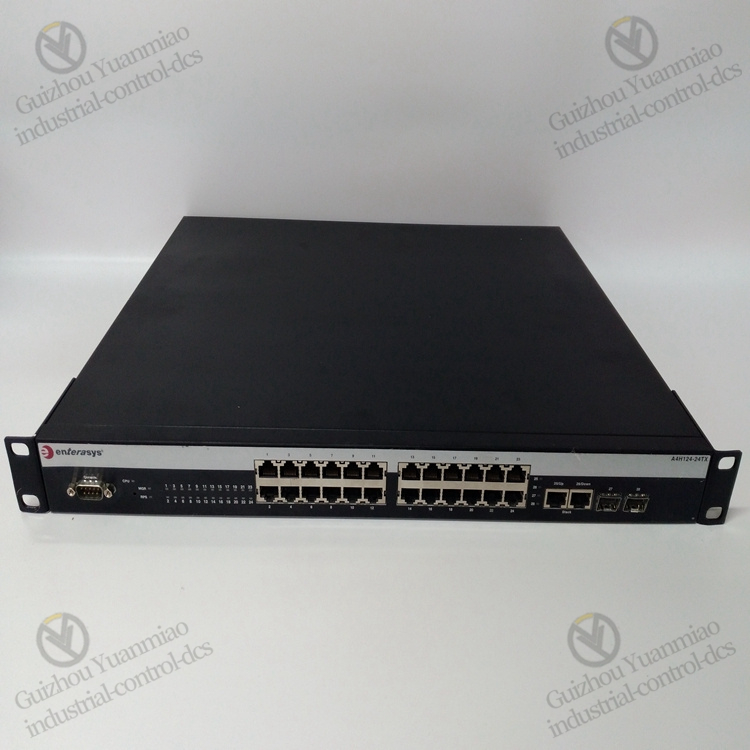
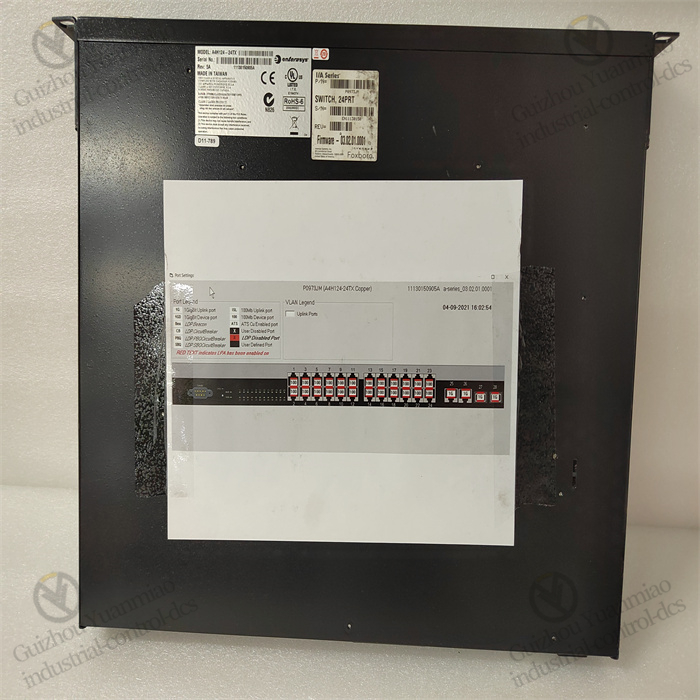
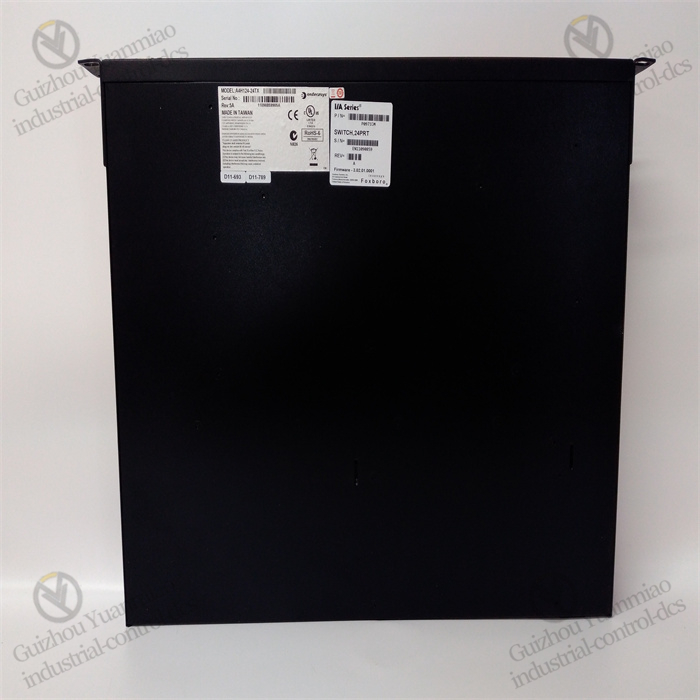
FOXBORO P0973JM 24-Port Managed Switch
The working principle of the FOXBORO P0973JM 24-port managed switch is based on the data link layer, and it realizes the forwarding of data frames by learning MAC addresses, as follows:
MAC Address Table Generation: The MAC address table of the switch is empty in the initial state. When a data frame enters the switch from a certain port, the switch reads the source MAC address in the frame header, binds it to the receiving port, and records it in the MAC address table. This process is called self-learning. At the same time, the switch has an aging mechanism. If a MAC address has not communicated for a long time (usually 300 seconds by default), it will be deleted from the MAC address table.
Data Frame Forwarding Decision: After the switch receives a data frame, it will query the destination MAC address. If the destination MAC address exists in the MAC address table, it indicates that the switch knows the port to which the device is connected, and will forward the data frame only to the corresponding port to achieve accurate transmission; if the destination MAC address is not in the table, the switch cannot determine its connected port and will broadcast the data frame to all ports except the receiving port. This situation is called unknown unicast frame flooding; if the destination MAC address is the broadcast address (FF:FF:FF:FF:FF:FF), the switch will also broadcast the data frame to all ports.
Forwarding Modes:
- Store-and-Forward: The switch first receives the complete data frame, then performs integrity check on the frame (such as CRC check), and forwards it only after confirming that it is correct. This mode can ensure that the forwarded data frames are correct, but there is a certain delay.
- Cut-Through: The switch forwards the data frame immediately after reading only the destination MAC address of the data frame, without waiting to receive the complete frame. This mode has a fast forwarding speed but cannot detect frame errors.
- Fragment-Free: The switch checks the first 64 bytes of the data frame (because collision fragments are usually smaller than this length), and forwards it if there is no problem. This method balances delay and error detection.
Collision Domain Segmentation and Loop Prevention:
- Collision Domain Segmentation: Each switch port is an independent collision domain. In full-duplex mode, the port can send and receive data at the same time without conflicts, thereby improving the utilization rate of network bandwidth.
- Spanning Tree Protocol (STP): To prevent problems such as broadcast storms caused by loops in the network, the FOXBORO P0973JM switch may run the Spanning Tree Protocol or its variants. By electing a root bridge and blocking redundant ports, an acyclic tree topology is formed, ensuring that there is only one active path for data transmission in the network.
Port Aggregation: The switch can bind multiple physical ports into a logical channel, that is, port aggregation. This can not only increase network bandwidth but also improve link reliability. Protocols such as LACP are usually used to implement the port aggregation function.
In addition, as a managed switch, the FOXBORO P0973JM also supports in-band and out-of-band management, and can be configured and managed through Telnet, Web interface, CLI commands, etc. Users can set VLANs, port parameters, QoS policies, etc., to meet different network needs and further optimize network performance and security.
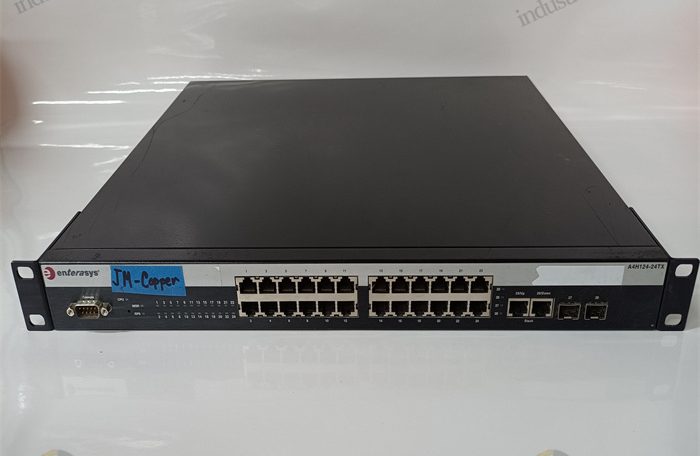
Port Configuration: It provides 24 100Base-TX ports with RJ-45 connectors for connecting Ethernet devices. It also has two fixed 10/100/1000 stacking/uplink (ISL) ports, which can be configured as uplink ports to facilitate connection with other switches or network devices. In addition, there are two 1000Base-X uplink Gigabit (SFP) ports, which can be installed with Mini-GBIC uplink (ISL) connector modules, such as P0972WT, P0972WU, etc., to further expand network connection capabilities.
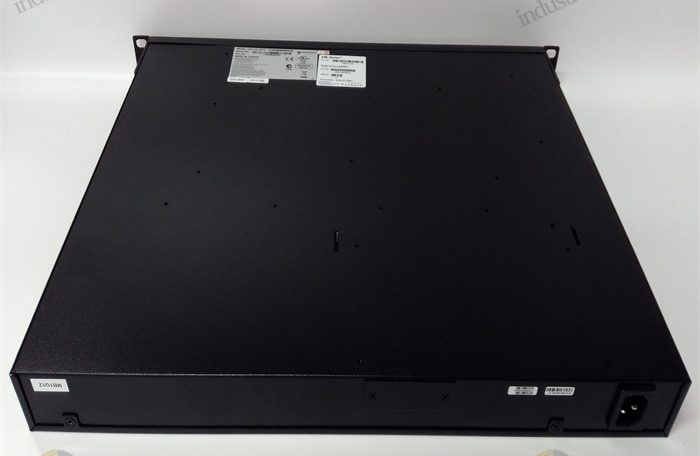
Working Mode: It supports full-duplex operation, which can send and receive data at the same time, improving data transmission efficiency.
Management Functions: Monitoring and configuration tasks can be performed through the local console port or any SNMP/RMON-based management application, facilitating network administrators to manage and maintain the switch.
Technical Standards: It complies with industry standards such as IEEE 802.3u Fast Ethernet and 802.1w Rapid Spanning Tree Protocol (RSTP), ensuring compatibility with other standard-compliant network devices and guaranteeing network stability and reliability.
Application Scenarios: It is suitable for small and medium-sized network applications, can realize high-performance, full-featured Layer 2 Ethernet switching, and high-performance direct end-station connection, and is often used in industrial automation networks and other scenarios.


Reviews
There are no reviews yet.