


Description
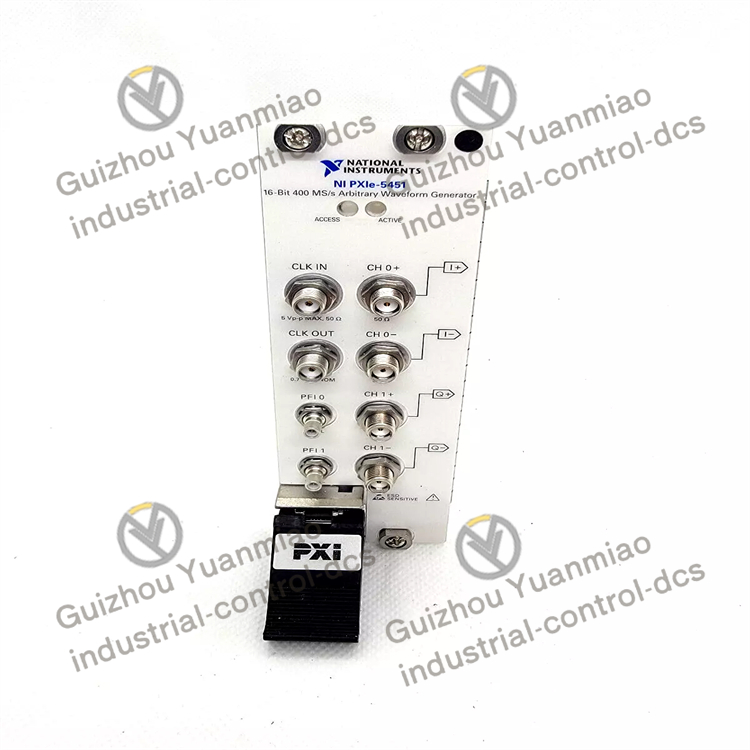
NI PXIE-5451 Arbitrary Waveform generator module
PXIE-5451 is a high-performance PXI Express arbitrary waveform generator module launched by NI (National Instruments), specifically designed for modular test systems.
Bandwidth: 145MHz, supporting the generation of high-frequency complex signals.
Number of channels: 2 analog output channels, supporting dual-channel synchronous output.
Resolution: 16-bit, voltage quantization accuracy reaches 65,536 levels, and it can output low-noise and high-fidelity signals.
Maximum sampling rate: 1GS/s (1 billion samplings per second), meeting the requirements of high-speed signal generation.
Driver and programming interface: Compatible with NI-SCOPE driver, supports programming in languages such as LabVIEW, Python, and C++, and can customize waveform parameters or control output in real time through API.
Graphical configuration tool: NI WaveForm Generator Software supports visual waveform editing, modulation parameter setting, or importing waveform data generated by Matlab.
System integration solution: Combined with NI TestStand and LabVIEW Test Module to construct an automated test process (such as the signal generation link in the mass production test of chips).
Application scenarios
Communication system test
Radio frequency and baseband signal simulation: Generate modulated signals within 145MHz (such as baseband IQ signals of GSM and Wi-Fi) to test the sensitivity of the receiver; Or simulate channel environments such as multipath fading and noise interference.
High-speed digital interface verification: Output high-speed clocks and data signals (such as differential signals of USB and PCIe), and test the compatibility of interface chips.
Testing of semiconductors and electronic components
Chip excitation signal: It provides high-precision input signals for ADC/DAC, operational amplifiers and other devices, verifying their conversion accuracy, linearity and other indicators.
Sensor calibration: Generate standard excitation signals (such as sine wave sweep frequency) to calibrate the response characteristics of pressure sensors and accelerometers.
Research on Audio and acoustics
High-fidelity audio signal generation: 16-bit resolution combined with low-distortion characteristics can simulate music and voice signals to test the frequency response and distortion of audio systems. Or generate ultrasonic signals (such as a 40kHz mosquito repellent waveform).
Scientific research and educational experiments
Physics and optics experiments: Generate pulse signals to drive lasers, leds, or simulate electromagnetic wave waveforms (such as interference and diffraction experiments); It is used in university laboratories for teaching courses such as Signals and Systems, and Principles of Communication.
Radar and remote sensing simulation: Generate pulse train signals through sequence triggering function, simulate the timing of radar echoes, and test the target detection capability at the receiving end.
Reviews
There are no reviews yet.